This research explores the effective dynamics of loop quantum $R^2$ cosmology, revealing that classical solutions converge to a unique fixed point, whereas loop quantum dynamics introduce a new saddle point. Critical solutions originating from this saddle point lead to bounce scenarios at small scalar field values, while other solutions, including inflation, exhibit problematic histories with $\phi < 0$.
Abstract
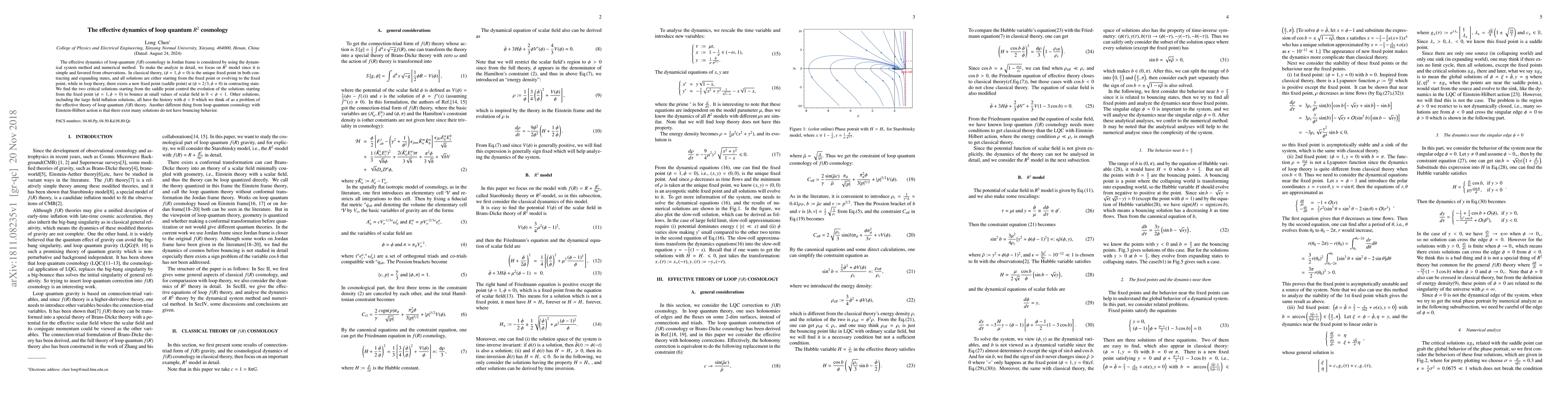
The effective dynamics of loop quantum $f (R)$ cosmology in Jordan frame is considered by using the dynamical system method and numerical method. To make the analyze in detail, we focus on $R^2$ model since it is simple and favored from observations. In classical theory, $(\phi = 1, \dot{\phi} = 0)$ is the unique fixed point in both contracting and expanding states, and all solutions are either starting from the fixed point or evolving to the fixed point; while in loop theory, there exists a new fixed point (saddle point) at $(\phi \simeq 2 / 3,\dot{\phi} = 0)$ in contracting state. We find the two critical solutions starting from the saddle point control the evolution of the solutions starting from the fixed point $(\phi = 1, \dot{\phi} = 0)$ to bounce at small values of scalar field in $0 <\phi < 1$. Other solutions, including the large field inflation solutions, all have the history with $\phi < 0$ which we think of as a problem of the effective theory of loop quantum $f(R)$ theory. Another different thing from loop quantum cosmology with Einstein-Hilbert action is that there exist many solutions do not have bouncing behavior.
Analysis
AI-generated · verify against the original paper
Generated Sep 5, 2025ResultsWhat the authors found
- Main finding 1
- Main finding 2
- Main finding 3
LimitationsWhere the findings need caution
- Limitation 1
- Limitation 2
MethodologyHow the work was done
Brief description of the research methodology used
SignificanceWhy the work matters
Why this research is important and its potential impact
Technical contributionsWhat the work introduces
Main technical or theoretical contribution
NoveltyHow it differs from prior work
What makes this work novel or different from existing research
Future workQuestions that remain
- Suggested direction 1
- Suggested direction 2
Discussion 0