The Self-Assembling Brain: Emergent Routing and Its Open Challenges
Abstract
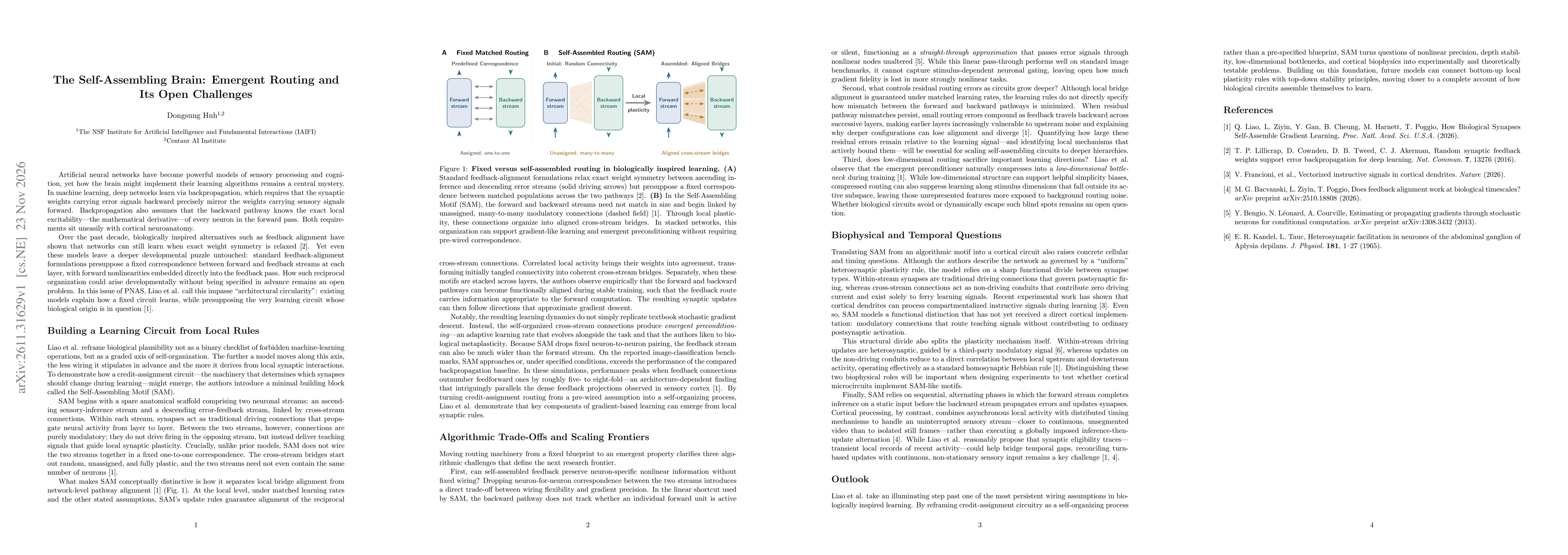
Biologically inspired alternatives to backpropagation, such as feedback alignment, relax the requirement for exact synaptic weight symmetry but still presuppose a fixed, pre-wired correspondence between forward and feedback pathways, an impasse Liao et al. (PNAS, 2026) term "architectural circularity." This commentary examines their Self-Assembling Motif (SAM), which reframes credit assignment as a self-organizing process driven by local synaptic rules. By linking ascending inference and descending feedback streams through initially random cross-stream connections, SAM supports local bridge alignment and emergent pathway alignment during stable training without fixed neuron-to-neuron pairing. Its resulting learning dynamics also exhibit adaptive preconditioning. The commentary highlights the algorithmic, biophysical, and temporal challenges that define the next research frontier: loss of neuron-specific nonlinear gating under straight-through approximation, compounding routing errors in deeper hierarchies, low-dimensional routing bottlenecks, the cortical implementation of non-driving modulatory connections, and the shift from alternating inference-update phases to continuous sensory processing.
AI Key Findings
Get AI-generated insights about this paper's methodology, results, significance, and more — available when analysis has been generated.
Discussion 0