The Wavefront Control System for the National Ignition Facility
The National Ignition Facility's wavefront control system corrects laser beam aberrations in real-time using a 39-actuator deformable mirror and a 77-lenslet Hartmann sensor, achieving a 50 um rms pointing accuracy and focusing 1.8 MJ of laser energy. The system employs adaptive optics algorithms and a distributed architecture for efficient wavefront compensation.
Abstract
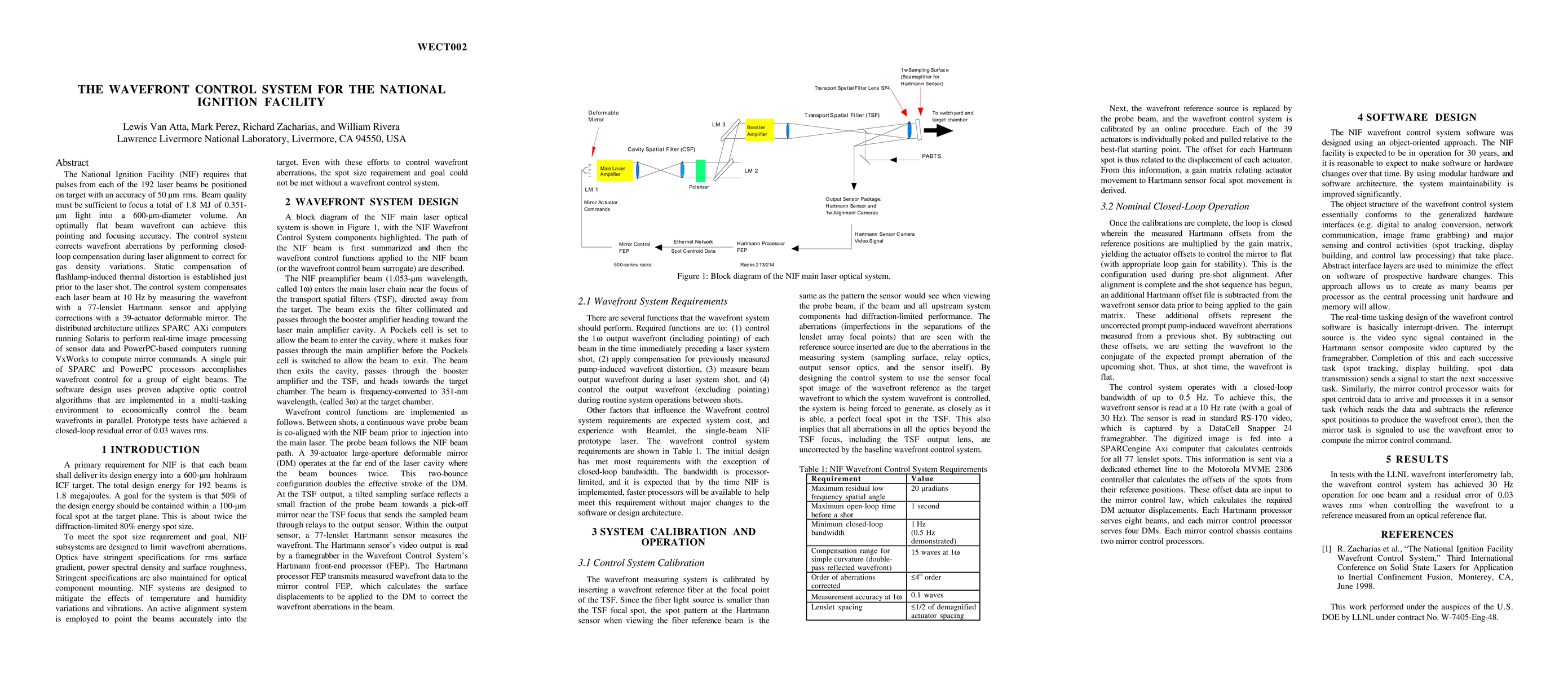
The National Ignition Facility (NIF) requires that pulses from each of the 192 laser beams be positioned on target with an accuracy of 50 um rms. Beam quality must be sufficient to focus a total of 1.8 MJ of 0.351-um light into a 600-um-diameter volume. An optimally flat beam wavefront can achieve this pointing and focusing accuracy. The control system corrects wavefront aberrations by performing closed-loop compensation during laser alignment to correct for gas density variations. Static compensation of flashlamp-induced thermal distortion is established just prior to the laser shot. The control system compensates each laser beam at 10 Hz by measuring the wavefront with a 77-lenslet Hartmann sensor and applying corrections with a 39-actuator deformable mirror. The distributed architecture utilizes SPARC AXi computers running Solaris to perform real-time image processing of sensor data and PowerPC-based computers running VxWorks to compute mirror commands. A single pair of SPARC and PowerPC processors accomplishes wavefront control for a group of eight beams. The software design uses proven adaptive optic control algorithms that are implemented in a multi-tasking environment to economically control the beam wavefronts in parallel. Prototype tests have achieved a closed-loop residual error of 0.03 waves rms.
AI Key Findings
Get AI-generated insights about this paper's methodology, results, significance, and more — available when analysis has been generated.
Discussion 0