This paper explores how closed string tachyons induce significant spacetime topology changes, including the loss of genus and the separation of Riemann surfaces, driven by localized Scherk-Schwarz winding tachyons. The study suggests that the decay of these tachyons can split spacetime tubes, affecting gauge fields and charges, and provides insights into the dynamics of such transitions.
Abstract
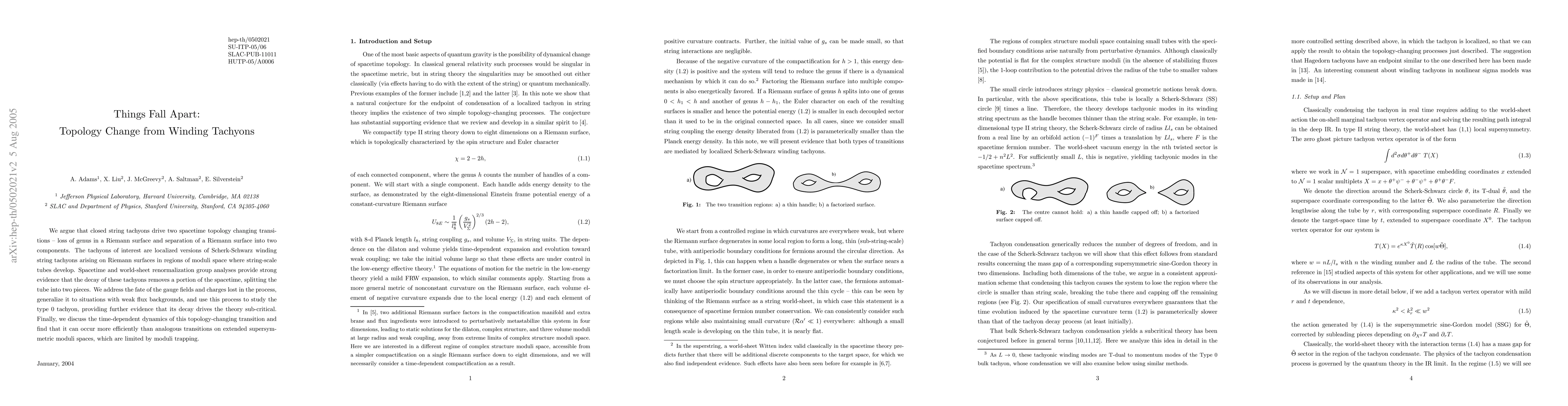
We argue that closed string tachyons drive two spacetime topology changing transitions -- loss of genus in a Riemann surface and separation of a Riemann surface into two components. The tachyons of interest are localized versions of Scherk-Schwarz winding string tachyons arising on Riemann surfaces in regions of moduli space where string-scale tubes develop. Spacetime and world-sheet renormalization group analyses provide strong evidence that the decay of these tachyons removes a portion of the spacetime, splitting the tube into two pieces. We address the fate of the gauge fields and charges lost in the process, generalize it to situations with weak flux backgrounds, and use this process to study the type 0 tachyon, providing further evidence that its decay drives the theory sub-critical. Finally, we discuss the time-dependent dynamics of this topology-changing transition and find that it can occur more efficiently than analogous transitions on extended supersymmetric moduli spaces, which are limited by moduli trapping.
AI Key Findings
Get AI-generated insights about this paper's methodology, results, significance, and more — available when analysis has been generated.
Discussion 0