Three Stages of ISAC Signal Design: Principles, Methods and Standardization
Abstract
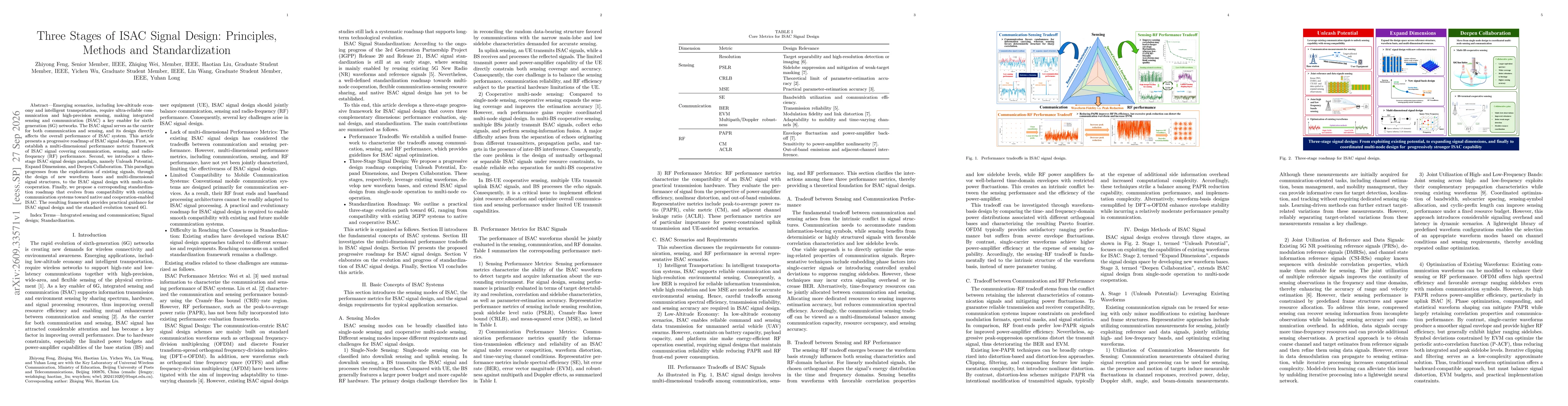
Emerging scenarios, including low-altitude economy and intelligent transportation, require ultra-reliable communi- cation and high-precision sensing, making integrated sensing and communication (ISAC) a key enabler for sixth-generation (6G) networks. The ISAC signal serves as the carrier for both communication and sensing, and its design directly affects the overall performance of ISAC system. This article presents a progressive roadmap of ISAC signal design. First, we establish a multi-dimensional performance metric framework of ISAC signal covering communication, sensing, and radio-frequency (RF) performance. Second, we introduce a three-stage ISAC signal design paradigm, namely UNLEASH POTENTIAL, EXPAND DIMENSIONS, and DEEPEN COLLABORATION. This paradigm progresses from the exploitation of existing signals, through the design of new waveform bases and multi-dimensional signal structures, to the ISAC signal design with multi-node cooperation. Finally, we propose a corresponding standardization roadmap that evolves from compatibility with existing communication sys- tems toward native and cooperation-enabled ISAC. The resulting framework provides practical guidance for ISAC signal design and the standard evolution toward 6G.
AI Key Findings
Get AI-generated insights about this paper's methodology, results, significance, and more — available when analysis has been generated.
Discussion 0