This research investigates the topological Magnus responses in 2D and 3D systems, revealing that warping and strain affect the Magnus Hall effect in monolayer graphene and topological insulators. In 3D, Magnus responses in multi-Weyl semimetals depend on the tilt, providing a way to differentiate between untilted and tilted WSMs.
Abstract
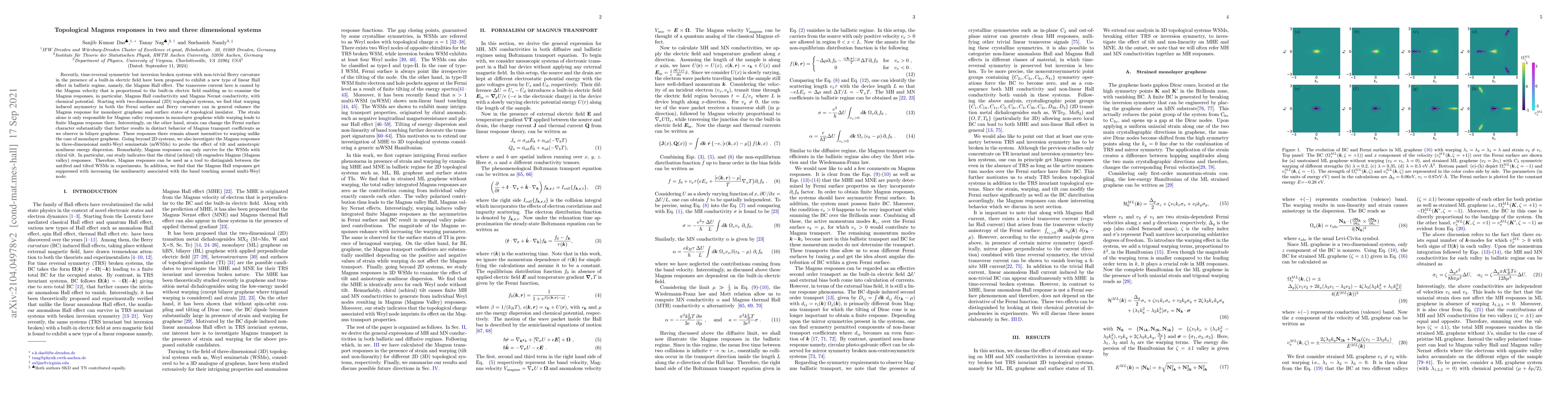
Recently, time-reversal symmetric but inversion broken systems with non-trivial Berry curvature in the presence of a built-in electric field have been proposed to exhibit a new type of linear Hall effect in ballistic regime, namely, the Magnus Hall effect. The transverse current here is caused by the Magnus velocity that is proportional to the built-in electric field allowing us to examine the Magnus Hall conductivity and Magnus Nernst conductivity with chemical potential. Starting with two-dimensional (2D) topological systems, we find that warping induced asymmetry in both the Fermi surface and Berry curvature can in general enhance the Magnus Hall response for monolayer graphene and surface states of topological insulator. Interestingly, strain can change the Fermi surface character substantially that further results in distinct behavior of Magnus transport coefficients as we observe in bilayer graphene. Going beyond 2D systems, we also investigate the Magnus Hall and Nernst responses in three-dimensional multi-Weyl semimetals (mWSMs). Remarkably, Magnus responses can only survive for the tilted WSMs, and therefore can be measured as a tool to distinguish between the untilted and tilted WSMs in experiments. In addition, we find that the Magnus Hall responses get suppressed with increasing the non-linearity associated with the band touching around multi-Weyl node.
AI Key Findings
Get AI-generated insights about this paper's methodology, results, significance, and more — available when analysis has been generated.
Discussion 0