Topological spin textures in electronic non-Hermitian systems
This paper demonstrates the emergence of topological soliton spin textures in the surface states of topological insulators under spin-dependent relaxation, revealing robust non-Hermitian features detectable via spectroscopic techniques. The study also shows that these spin textures can be transformed through topological transitions, offering a pathway for engineering spin dissipation in solid-state systems.
Abstract
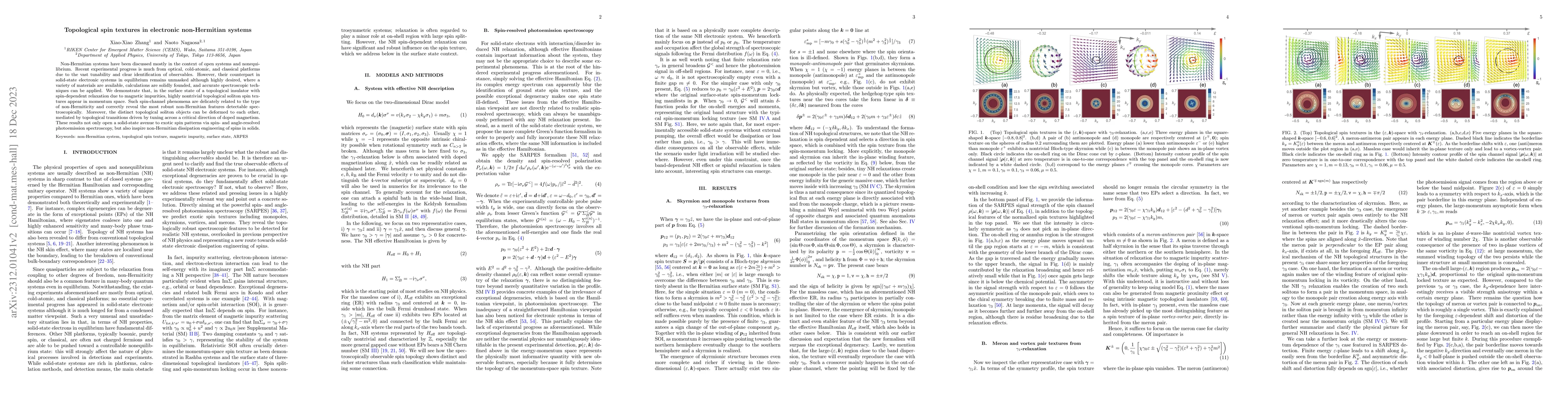
Non-Hermitian systems have been discussed mostly in the context of open systems and nonequilibrium. Recent experimental progress is much from optical, cold-atomic, and classical platforms due to the vast tunability and clear identification of observables. However, their counterpart in solid-state electronic systems in equilibrium remains unmasked although highly desired, where a variety of materials are available, calculations are solidly founded, and accurate spectroscopic techniques can be applied. We demonstrate that, in the surface state of a topological insulator with spin-dependent relaxation due to magnetic impurities, highly nontrivial topological soliton spin textures appear in momentum space. Such spin-channel phenomena are delicately related to the type of non-Hermiticity and correctly reveal the most robust non-Hermitian features detectable spectroscopically. Moreover, the distinct topological soliton objects can be deformed to each other, mediated by topological transitions driven by tuning across a critical direction of doped magnetism. These results not only open a solid-state avenue to exotic spin patterns via spin- and angle-resolved photoemission spectroscopy, but also inspire non-Hermitian dissipation engineering of spins in solids.
AI Key Findings
Get AI-generated insights about this paper's methodology, results, significance, and more — available when analysis has been generated.
Discussion 0