Towards a full-stack functionalist theory of consciousness: Identifying its functional profile
Abstract
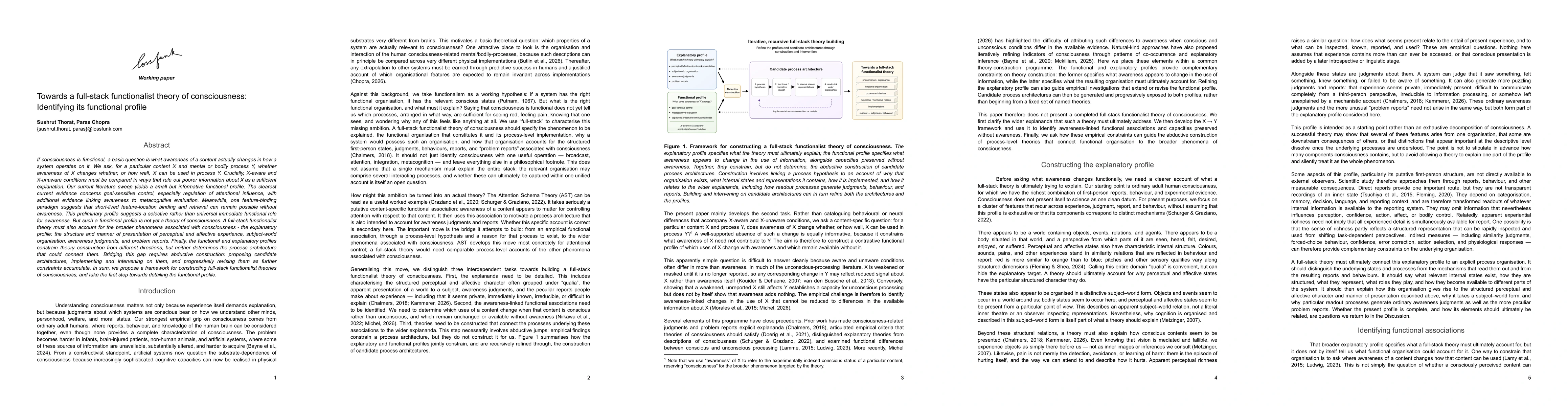
If consciousness is functional, a basic question is what awareness of a content actually changes in how a system operates on it. We ask, for a particular content X and mental or bodily process Y, whether awareness of X changes whether, or how well, X can be used in process Y. Crucially, X-aware and X-unaware conditions must be compared in ways that rule out poorer information about X as a sufficient explanation. Our current literature sweep yields a small but informative functional profile. The clearest current evidence concerns goal-sensitive control, especially regulation of attentional influence, with additional evidence linking awareness to metacognitive evaluation. Meanwhile, one feature-binding paradigm suggests that short-lived feature-location binding and retrieval can remain possible without awareness. This preliminary profile suggests a selective rather than universal immediate functional role for awareness. But such a functional profile is not yet a theory of consciousness. A full-stack functionalist theory must also account for the broader phenomena associated with consciousness - the explanatory profile: the structure and manner of presentation of perceptual and affective experience, subject-world organisation, awareness judgments, and problem reports. Finally, the functional and explanatory profiles constrain theory construction from different directions, but neither determines the process architecture that could connect them. Bridging this gap requires abductive construction: proposing candidate architectures, implementing and intervening on them, and progressively revising them as further constraints accumulate. In sum, we propose a framework for constructing full-stack functionalist theories of consciousness, and take the first step towards detailing the functional profile.
AI Key Findings
Get AI-generated insights about this paper's methodology, results, significance, and more — available when analysis has been generated.
Discussion 0