Towards end-to-end co-design for one-shot printable task-specific soft robots
Abstract
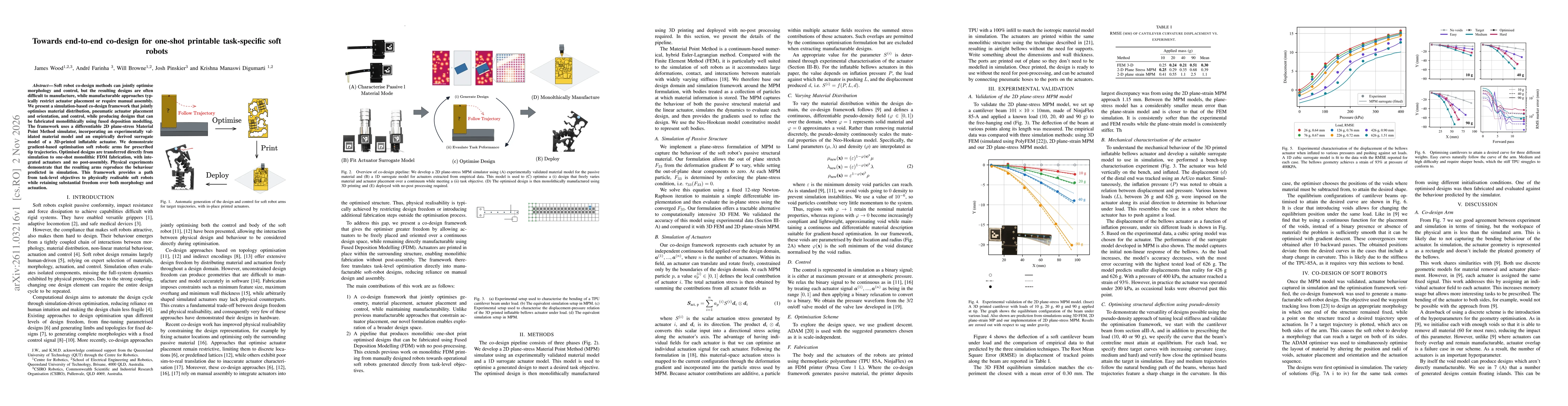
Soft robot co-design methods can jointly optimise morphology and control, but the resulting designs are often difficult to manufacture, while manufacturable approaches typically restrict actuator placement or require manual assembly. We present a simulation-based co-design framework that jointly optimises material distribution, pneumatic actuator placement and orientation, and control, while producing designs that can be fabricated monolithically using fused deposition modelling. The framework uses a differentiable 2D plane-stress Material Point Method simulator, incorporating an experimentally validated material model and an empirically derived surrogate model of a 3D-printed inflatable actuator. We demonstrate gradient-based optimisation soft robotic arms for prescribed tip trajectories. Optimised designs are transferred directly from simulation to one-shot monolithic FDM fabrication, with integrated actuators and no post-assembly. Physical experiments demonstrate that the resulting arms reproduce the behaviour predicted in simulation. This framework provides a path from task-level objectives to physically realisable soft robots while retaining substantial freedom over both morphology and actuation.
Analysis
AI-generated · verify against the original paper
Generated Jan 1, 0001ResultsWhat the authors found
- Gradient‑based co‑design produces soft robotic arms that accurately follow prescribed tip trajectories in simulation.
- Optimized designs are transferred directly from simulation to one‑shot monolithic FDM fabrication with integrated actuators and no post‑processing.
- Physical experiments confirm that the fabricated arms reproduce the simulated behavior.
- The framework enables free placement and orientation of actuators while maintaining manufacturability.
LimitationsWhere the findings need caution
- The current void‑handling approach lacks minimum resolution enforcement, which can lead to unconnected particles in the design.
- Explicit manufacturability constraints (e.g., minimum feature sizes) are not yet incorporated into the optimization.
- The study is limited to 2D plane‑stress simulations and pneumatic inflatable actuators, which may not capture full 3D effects or other actuation modalities.
MethodologyHow the work was done
The authors develop a differentiable 2D plane‑stress Material Point Method (MPM) simulator that incorporates an experimentally validated material model for the passive substrate and a 1D surrogate model of a 3D‑printed inflatable pneumatic actuator. Using gradient‑based optimization, they jointly optimize material distribution, actuator placement and orientation, and control to meet task‑level objectives, and then fabricate the optimized designs monolithically via fused deposition modelling (FDM) without post‑assembly.
SignificanceWhy the work matters
This work provides a complete end‑to‑end pipeline that bridges task‑level objectives and physically realizable soft robots, offering substantial design freedom without sacrificing manufacturability, and thus advances the practical deployment of soft robotic systems.
Technical contributionsWhat the work introduces
A co‑design framework that integrates a differentiable MPM simulator with a surrogate pneumatic actuator model, enabling joint optimization of morphology, material distribution, actuator placement, orientation, and control, and producing designs directly printable as monolithic soft robots via FDM.
NoveltyHow it differs from prior work
It is the first approach to allow unrestricted placement and orientation of printable pneumatic actuators within a continuous design space while guaranteeing one‑shot monolithic fabrication, thus reconciling high design freedom with manufacturability.
Future workQuestions that remain
- Introduce explicit manufacturability rules such as minimum feature size and overhang constraints.
- Extend the MPM formulation to model other actuator types, including motor‑tendon systems.
- Improve resolution constraints to prevent disconnected regions and enhance design robustness.
- Explore 3D extensions of the framework for more complex soft robot geometries.
Discussion 0