Tracer dynamics in polymer networks: generalized Langevin description
This paper investigates the dynamics of tracer diffusion in polymer networks using generalized Langevin simulations, revealing the interplay between short-time dynamics, polymer fluctuations, and viscoelastic response. It proposes a reduced functional form for tracer memory, enabling efficient simulations via the generalized Langevin equation.
Abstract
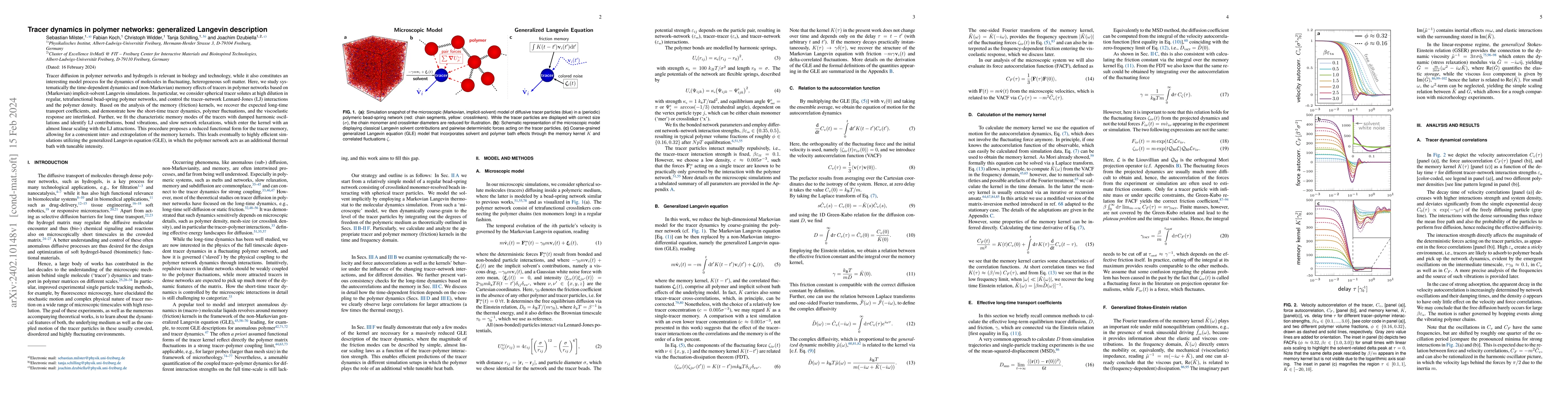
Tracer diffusion in polymer networks and hydrogels is relevant in biology and technology, while it also constitutes an interesting model process for the dynamics of molecules in fluctuating, heterogeneous soft matter. Here, we study systematically the time-dependent dynamics and (non-Markovian) memory effects of tracers in polymer networks based on (Markovian) implicit-solvent Langevin simulations. In particular, we consider spherical tracer solutes at high dilution in regular, tetrafunctional bead-spring polymer networks, and control the tracer-network Lennard-Jones (LJ) interactions and the polymer density. Based on the analysis of the memory (friction) kernels, we recover the expected long-time transport coefficients, and demonstrate how the short-time tracer dynamics, polymer fluctuations, and the viscoelastic response are interlinked. Further, we fit the characteristic memory modes of the tracers with damped harmonic oscillations and identify LJ contributions, bond vibrations, and slow network relaxations, which enter the kernel with an almost linear scaling with the LJ attractions. This procedure proposes a reduced functional form for the tracer memory, allowing for a convenient inter- and extrapolation of the memory kernels. This leads eventually to highly efficient simulations utilizing the generalized Langevin equation (GLE), in which the polymer network acts as an additional thermal bath with tuneable intensity.
AI Key Findings
Get AI-generated insights about this paper's methodology, results, significance, and more — available when analysis has been generated.
Discussion 0