TrajWAM: Trajectory-Conditioned Future Learning for Vision-Language Driving
Abstract
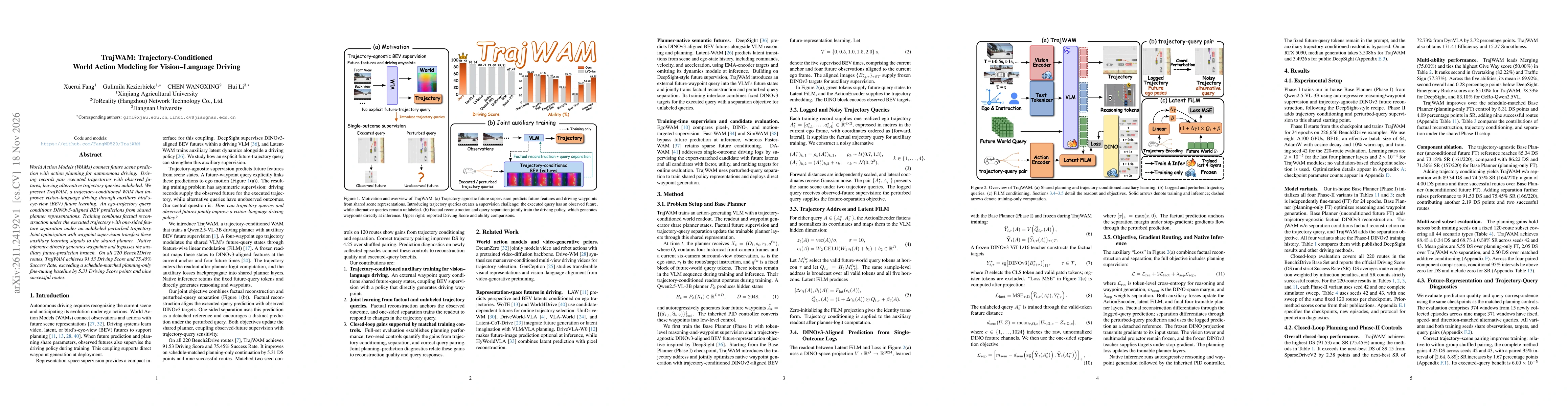
World Action Models (WAMs) connect future scene prediction with action planning for autonomous driving. Each driving record pairs an executed ego trajectory with its observed future, providing a factual outcome for learning this connection. We present TrajWAM, a trajectory-conditioned WAM that improves vision-language driving through auxiliary bird's-eye-view (BEV) future learning. An ego-trajectory query conditions DINOv3-aligned BEV predictions from shared planner representations. Training combines factual reconstruction under the executed trajectory with one-sided feature separation under an unlabeled perturbed trajectory. Together, these objectives train the shared planner to generate driving waypoints. Native inference directly generates waypoints and bypasses the auxiliary future-prediction branch. On all 220 Bench2Drive routes, TrajWAM achieves 91.53 Driving Score and 75.45% Success Rate, exceeding a schedule-matched planning-only fine-tuning baseline by 5.31 Driving Score points and eight successful routes.
Analysis
AI-generated · verify against the original paper
Generated Jan 1, 0001ResultsWhat the authors found
- Achieves 91.53 Driving Score and 75.45% Success Rate on all 220 Bench2Drive routes.
- Outperforms a schedule‑matched planning‑only fine‑tuning baseline by 5.31 Driving Score points and adds nine successful routes.
- Correct trajectory‑pairing improves Driving Score by 4.67 points over shuffled pairing.
- Ablation without separation reduces the gain to +2.05 Driving Score points.
LimitationsWhere the findings need caution
- Evaluation is limited to CARLA/Bench2Drive simulations with only one full‑set training seed and two seeds for component controls.
- The public initializer’s pre‑training route coverage is unknown, limiting insight into generalization.
- Real‑world transfer and alternative action outcome evaluation are not addressed.
MethodologyHow the work was done
TrajWAM trains a Qwen2.5-VL-3B driving planner with an auxiliary bird's-eye-view (BEV) future prediction branch conditioned on an ego-trajectory query. The trajectory query modulates shared planner representations via FiLM, and the BEV predictions are aligned to DINOv3 features. Training jointly optimizes factual reconstruction of the observed future under the executed trajectory and a one‑sided feature‑separation loss for unlabeled perturbed trajectories, updating the shared planner so that at inference only waypoint generation is needed.
SignificanceWhy the work matters
The results demonstrate that conditioning future prediction on explicit ego‑trajectory queries and jointly learning factual reconstruction and query separation substantially boosts vision‑language driving performance, closing the gap between prediction‑aware and pure planning models.
Technical contributionsWhat the work introduces
Introduces a trajectory‑conditioned auxiliary BEV future learning module that shares parameters with the driving planner, and proposes a joint factual reconstruction and one‑sided query separation training objective to align planner representations with trajectory‑specific future predictions.
NoveltyHow it differs from prior work
First work to integrate explicit ego‑trajectory conditioning into World Action Models for vision‑language driving, coupling auxiliary future prediction with waypoint generation via shared planner representations.
Future workQuestions that remain
- Assess alternative action outcomes and training‑seed variation to gauge robustness.
- Extend evaluation to real‑world driving scenarios to verify transferability.
- Explore broader pre‑training coverage and additional trajectory query designs.
Discussion 0