Abstract
With the widespread adoption of Vision Transformers in modern AI, the need to analyze their inherent representational behavior has become increasingly important. While most existing studies emphasize token geometries and training dynamics, the evolution of representational covariance structures and class-level geometric organization remains comparatively underexplored. In this work, we investigate semantic geometry and class separability as representations evolve across the layers of ViT-Small/16 through TGO-III: Semantic Geometry Observatory. It is a framework designed to analyze the emergence of semantic organization, feature evolution, and class-wise representation geometry throughout training. The framework employs multiple complementary observatories, including Linear Probe Accuracy, Fisher Ratio, Class Centroid Distances, Local Intrinsic Dimension, and Local PCA Rank, to quantify the progressive evolution of discriminative representations. Our analysis reveals that class representations become progressively more linearly separable, Fisher discriminability increases, class centroids move farther apart, and local representation manifolds exhibit structured class-dependent geometric complexity. These observations provide empirical evidence supporting the Semantic Expansion Hypothesis, suggesting that the manifold expansion observed in previous observatories is accompanied by the progressive organization of representations into increasingly discriminative semantic structures. Collectively, TGO-III extends the Transformer Geometry Observatory framework by establishing a direct connection between manifold geometry, covariance evolution, and semantic organization during Transformer training.
Analysis
AI-generated · verify against the original paper
Generated Aug 5, 2026ResultsWhat the authors found
- Class representations become progressively more linearly separable as training proceeds, indicating enhanced class discrimination.
- Fisher discriminability increases and class centroids move farther apart, demonstrating growing inter-class separation in the representation space.
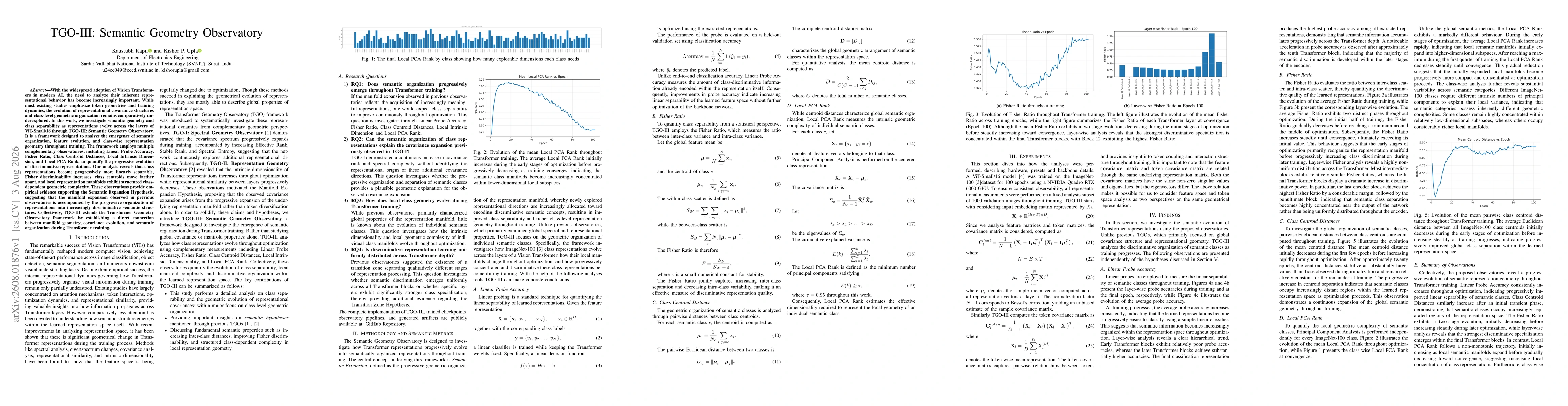
- Local PCA analyses reveal that local manifolds become more concentrated in later training stages, while still supporting increasing discriminative structure.
- Covariance directions expand alongside manifold expansion, interpreted as geometric manifestation of richer semantic organization.
- Layer-wise analysis shows strongest semantic discrimination emerges in the final Transformer blocks, supporting a non-uniform, progressive semantic specialization.
LimitationsWhere the findings need caution
- Focus is limited to ViT-Small/16 and ImageNet-100; generalization to other architectures or datasets remains to be tested.
- Observables are predominantly geometric/statistical; direct causal links to downstream task performance or robustness are not exhaustively explored.
- Reliance on linear probes may overlook nonlinear discriminative structures present in intermediate representations.
MethodologyHow the work was done
TGO-III introduces SemanticGeometryObservatory to analyze semantic organization during Transformer training using tools such as Linear Probe Accuracy, Fisher Ratio, Class Centroid Distances, Local Intrinsic Dimension, and Local PCA Rank to quantify class separability and local manifold geometry across layers.
SignificanceWhy the work matters
Empirically links covariance expansion, manifold growth, and semantic organization, reinforcing the Semantic Expansion and Manifold Expansion hypotheses and refining the Transition Zone view of where semantic specialization occurs during Transformer training.
Technical contributionsWhat the work introduces
Proposes a dedicated semantic observatory within the Transformer Geometry Observatory framework, introducing class-wise geometric analyses (Linear Probe, Fisher Ratio, Class Centroid Distances, Local Intrinsic Dimension, Local PCA Rank) to quantify semantic organization during training.
NoveltyHow it differs from prior work
Extends prior TGOs by focusing on class-level semantic organization, providing a unified geometric interpretation that ties covariance expansion, manifold growth, and semantic discrimination across Transformer depth.
Future workQuestions that remain
- Develop TGO-IV to study Developmental Topology and join token dynamics with semantic manifolds.
- Investigate Gradient Geometry and Optimization Dynamics to understand how gradients shape semantic manifolds.
- Explore Computational Dynamics and loss landscape analyses to connect spectral/geometry observations with optimization trajectories.
Discussion 0