TraVEL: Trajectory-Guided Video Embedding Learning for Driving-Video Retrieval
Abstract
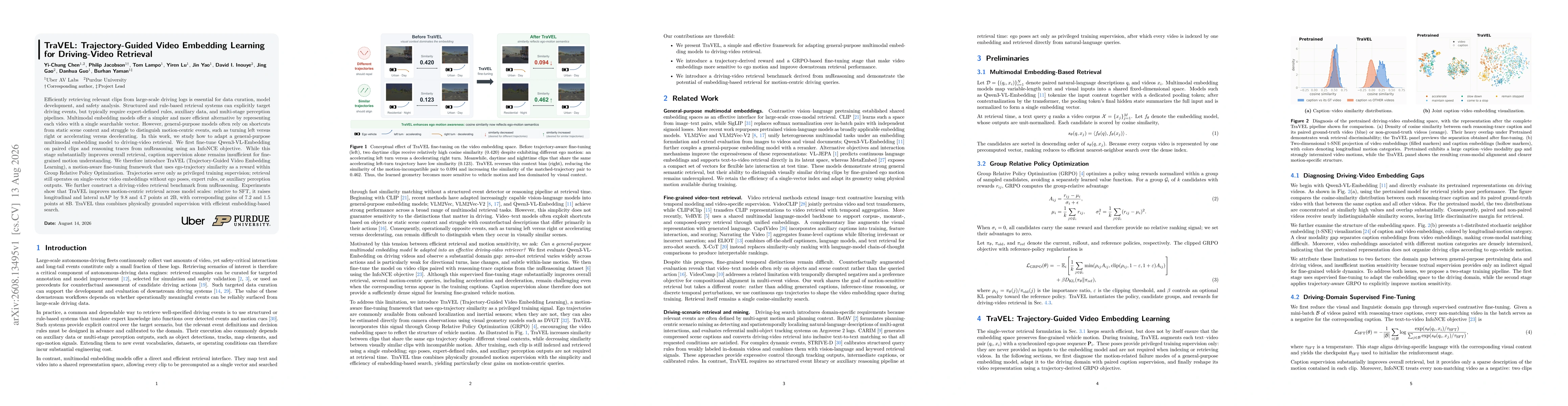
Efficiently retrieving relevant clips from large-scale driving logs is essential for data curation, model development, and safety analysis. Structured and rule-based retrieval systems can explicitly target driving events, but typically require expert-defined rules, auxiliary data, and multi-stage perception pipelines. Multimodal embedding models offer a simpler and more efficient alternative by representing each video with a single searchable vector. However, general-purpose models often rely on shortcuts from static scene context and struggle to distinguish motion-centric events, such as turning left versus right or accelerating versus decelerating. In this work, we study how to adapt a general-purpose multimodal embedding model to driving-video retrieval. We first fine-tune Qwen3-VL-Embedding on paired clips and reasoning traces from nuReasoning using an InfoNCE objective. While this stage substantially improves overall retrieval, caption supervision alone remains insufficient for fine-grained motion understanding. We therefore introduce TraVEL (Trajectory-Guided Video Embedding Learning), a motion-aware fine-tuning framework that uses ego-trajectory similarity as a reward within Group Relative Policy Optimization. Trajectories serve only as privileged training supervision; retrieval still operates on single-vector video embeddings without ego poses, expert rules, or auxiliary perception outputs. We further construct a driving-video retrieval benchmark from nuReasoning. Experiments show that TraVEL improves motion-centric retrieval across model scales: relative to SFT, it raises longitudinal and lateral mAP by 9.8 and 4.7 points at 2B, with corresponding gains of 7.2 and 1.5 points at 8B. TraVEL thus combines physically grounded supervision with efficient embedding-based search.
Analysis
AI-generated · verify against the original paper
Generated Aug 15, 2026ResultsWhat the authors found
- TraVEL improves motion-centric retrieval versus supervised fine-tuning (SFT), increasing longitudinal mAP by 9.8 points and lateral mAP by 4.7 points at 2B model scale.
- At 8B scale, TraVEL yields gains of 7.2 points in longitudinal mAP and 1.5 points in lateral mAP relative to SFT.
- TraVEL achieves these improvements without requiring ego poses or external perception outputs during retrieval, maintaining efficient single-vector search.
LimitationsWhere the findings need caution
- Trajectory-guided supervision relies on privileged training signals (ego-trajectory data) which may not always be available or accurately estimated in all datasets.
- The evaluation benchmark is constructed from nuReasoning, which may not capture all real-world driving scenarios or edge cases.
MethodologyHow the work was done
The study fine-tunes a general-purpose multimodal embedding model (Qwen3-VL-Embedding) on paired driving clips and reasoning traces from nuReasoning using an InfoNCE objective, and introduces TraVEL, a motion-aware fine-tuning framework that leverages ego-trajectory similarity as a reward within Group Relative Policy Optimization (GRPO) to align video embeddings with motion trajectories while keeping retrieval as single-vector embeddings at inference.
SignificanceWhy the work matters
The approach demonstrates that physically grounded trajectory supervision can be incorporated during training to enhance motion sensitivity in embedding-based driving-video retrieval, bridging the gap between efficient retrieval and fine-grained motion understanding without addingRetrieval-time overhead.
Technical contributionsWhat the work introduces
Proposes Trajectory-Guided Video Embedding Learning (TraVEL) that uses ego-trajectory similarity as a training reward within GRPO to impart motion-aware structure into video embeddings, enabling improved motion-centric retrieval while preserving single-vector inference.
NoveltyHow it differs from prior work
Introduces a motion-aware fine-tuning framework that injects privileged trajectory information into an embedding-based retrieval system through GRPO, specifically targeting fine-grained driving motions without requiring trajectory data at retrieval time.
Future workQuestions that remain
- Extend TraVEL to handle scenarios with imperfect or noisy ego-trajectory estimates and study robustness to sensor noise.
- Explore integrating TraVEL with additional modalities (e.g., audio, radar) to further boost motion-centric retrieval without sacrificing single-vector efficiency.
Discussion 0