TroPUF: Evaluating Hardware Trojan Insertion in Delay-Based Physical Unclonable Functions
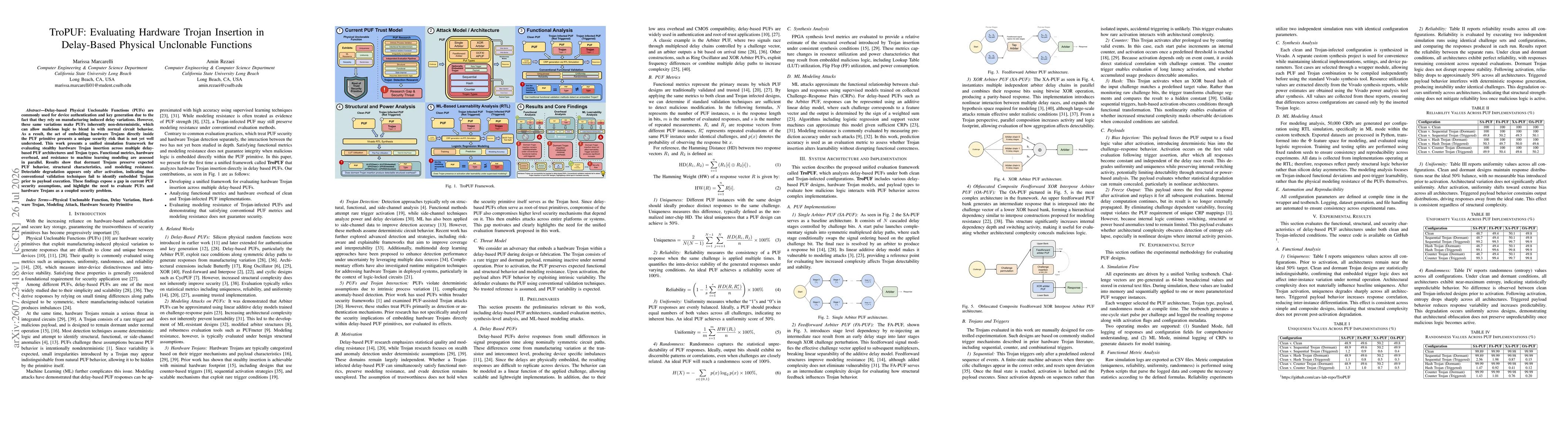
This paper introduces a unified simulation framework to evaluate hardware Trojan insertion in delay-based PUFs, covering multiple PUF architectures and Trojan types. It finds that dormant Trojans mimic normal PUF behavior and resist modeling until activation, implying conventional validation misses embedded Trojans and highlighting the need to treat PUFs and Trojans as a coupled security problem.
Abstract
Delay-based Physical Unclonable Functions (PUFs) are commonly used for device authentication and key generation due to the fact that they rely on manufacturing induced delay variations. However, these same variations make PUFs inherently non-deterministic, which can allow malicious logic to blend in with normal circuit behavior. As a result, the act of embedding hardware Trojans directly inside the PUF primitive presents a unique security risk that is not yet well understood. This work presents a unified simulation framework for evaluating stealthy hardware Trojan insertion across multiple delay-based PUF architectures and Trojan types. Functional metrics, hardware overhead, and resistance to machine learning modeling are assessed in parallel. Results show that dormant Trojans preserve expected PUF behavior, structural characteristics, and modeling resistance. Detectable degradation appears only after activation, indicating that conventional validation techniques fail to identify embedded Trojans prior to payload execution. These findings expose a gap in current PUF security assumptions, and highlight the need to evaluate PUFs and hardware Trojans as a coupled security problem.
AI Key Findings
Get AI-generated insights about this paper's methodology, results, significance, and more — available when analysis has been generated.
Discussion 0