This paper explores the tunable vortex dynamics in superconducting proximity junction arrays, demonstrating their potential as an accurate and sensitive 2D THz detector. The arrays can transition from a vortex Mott insulator to a vortex metal under electric and magnetic field changes, enabling new modulation techniques for radiation detection.
Abstract
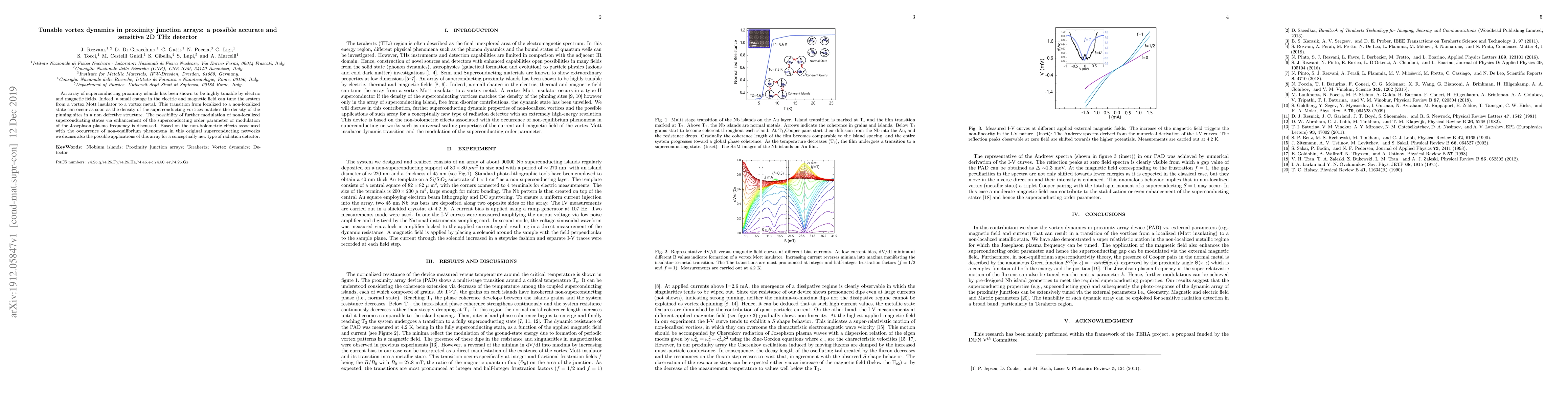
An array of superconducting proximity islands has been shown to be highly tunable by electric and magnetic fields. Indeed, a small change in the electric and magnetic field can tune the system from a vortex Mott insulator to a vortex metal. This transition from localized to a non-localized state can occur as soon as the density of the superconducting vortices matches the density of the pinning sites in a non defective structure. The possibility of further modulation of non-localized superconducting states via enhancement of the superconducting order parameter or modulation of the Josephson plasma frequency is discussed. Based on the non-bolometric effects associated with the occurrence of non-equilibrium phenomena in this original superconducting networks we discuss also the possible applications of this array for a conceptually new type of radiation detector.
AI Key Findings
Get AI-generated insights about this paper's methodology, results, significance, and more — available when analysis has been generated.
Discussion 0