Two-tone modulated cavity electromagnonics
This paper explores two-tone modulated cavity electromagnonics to enhance the coupling between microwave fields and magnon Kittle modes, enabling the generation of nonclassical magnonic states and ultra-sensitive magnon-based sensing through engineered backaction-evading interactions. The approach also facilitates the development of spintronics-related quantum information processing devices.
Abstract
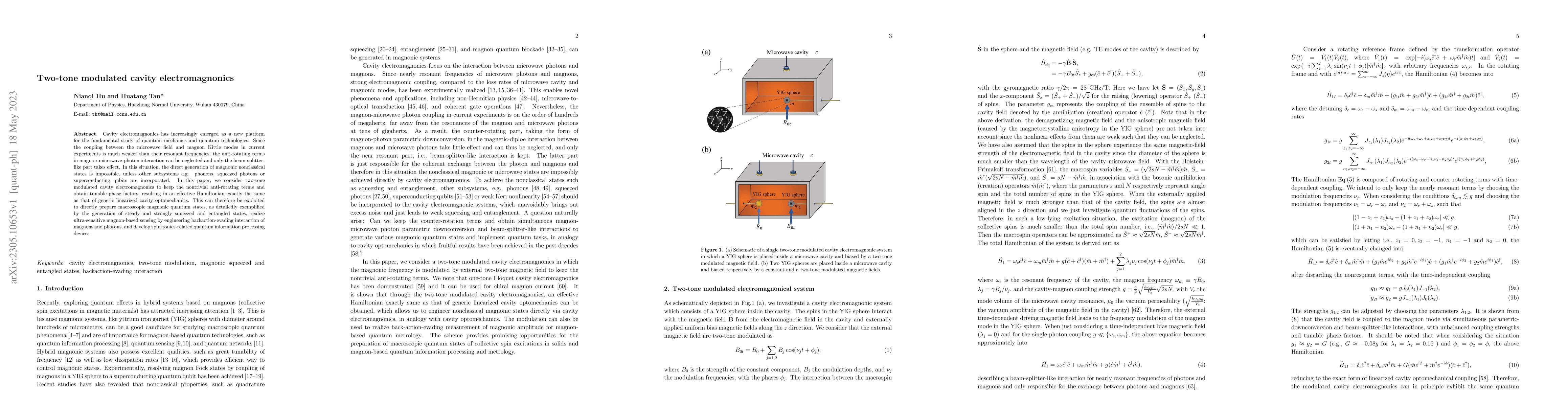
Cavity electromagnonics has increasingly emerged as a new platform for the fundamental study of quantum mechanics and quantum technologies. Since the coupling between the microwave field and magnon Kittle modes in current experiments is much weaker than their resonant frequencies, the anti-rotating terms in magnon-microwave-photon interaction can be neglected and only the beam-splitter-like part takes effect. In this situation, the direct generation of magnonic nonclassical states is impossible, unless other subsystems e.g. phonons, squeezed photons or superconducting qubits are incorporated. In this paper, we consider two-tone modulated cavity electromagnonics to keep the nontrivial anti-rotating terms and obtain tunable phase factors, resulting in an effective Hamiltonian exactly the same as that of generic linearized cavity optomechanics. This can therefore be exploited to directly prepare macroscopic magnonic quantum states, as detailedly exemplified by the generation of steady and strongly squeezed and entangled states, realize ultra-sensitive magnon-based sensing by engineering backaction-evading interaction of magnons and photons, and develop spintronics-related quantum information processing devices.
AI Key Findings
Get AI-generated insights about this paper's methodology, results, significance, and more — available when analysis has been generated.
Discussion 0