Ultra-low Frequency Noise External Cavity Diode Laser Systems for Quantum Applications
This research explores two ultra-low frequency noise diode lasers at 729 nm, comparing their performance and suitability for quantum applications. The study finds distinct operational behaviors in each system and assesses their linewidth reduction and locking capabilities, highlighting their potential for high-precision quantum technologies.
Abstract
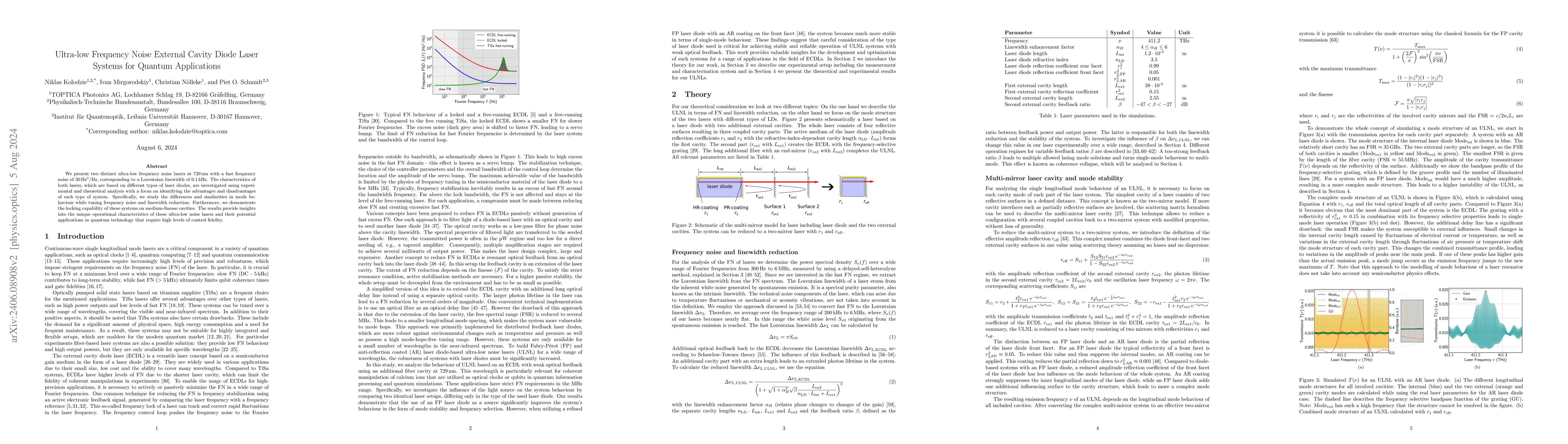
We present two distinct ultra-low frequency noise lasers at 729 nm with a fast frequency noise of 30 Hz^2/Hz, corresponding to a Lorentzian linewidth of 0.1 kHz. The characteristics of both lasers, which are based on different types of laser diodes, are investigated using experimental and theoretical analysis with a focus on identifying the advantages and disadvantages of each type of system. Specifically, we study the differences and similarities in mode behaviour while tuning frequency noise and linewidth reduction. Furthermore, we demonstrate the locking capability of these systems on medium-finesse cavities. The results provide insights into the unique operational characteristics of these ultra-low noise lasers and their potential applications in quantum technology that require high levels of control fidelity.
AI Key Findings
Get AI-generated insights about this paper's methodology, results, significance, and more — available when analysis has been generated.
Discussion 0