Ultralow Threshold, Single-Mode InGaAs/GaAs Multi-Quantum Disk Nanowire Lasers
The research presents ultralow threshold, single-mode nanowire lasers for near-infrared light, achieved by controlling nanowire diameter and length to minimize cavity modes. Enhanced performance is maintained through InGaAs/GaAs multi-quantum disks and an AlGaAs shell passivation. At 5K, a threshold of 1.6 μJ/cm² is attained with a Q-factor over 6400. Room temperature operation is demonstrated with a threshold of 48 μJ/cm², high characteristic temperature, and a power output of ~0.9 μW. These lasers are promising for integrated photonics, sensing, and spectroscopy applications.
Abstract
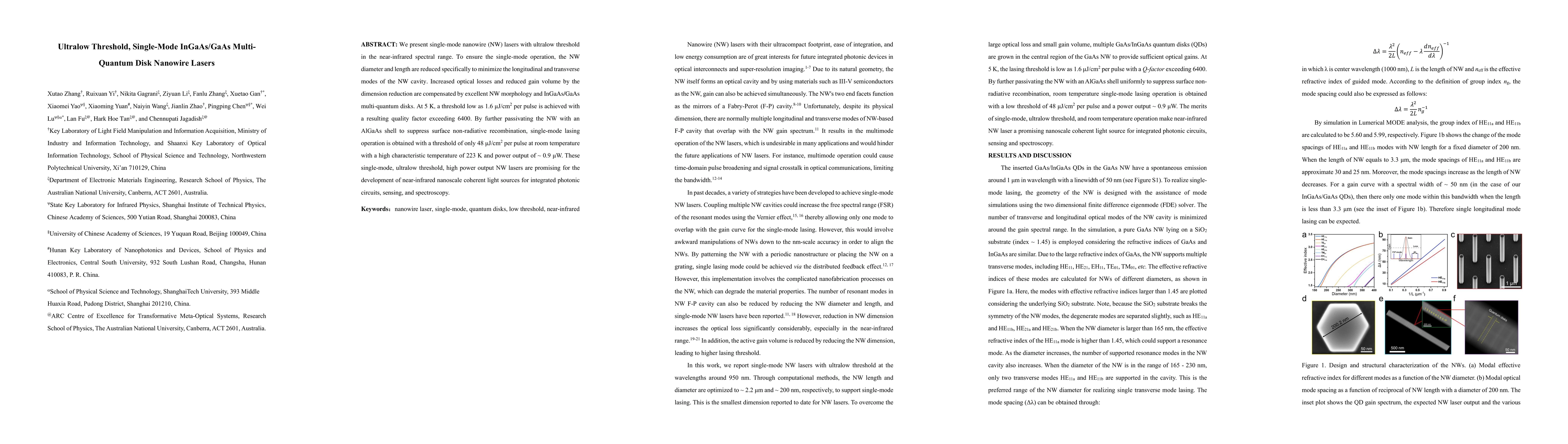
We present single-mode nanowire (NW) lasers with ultralow threshold in the near-infrared spectral range. To ensure the single-mode operation, the NW diameter and length are reduced specifically to minimize the longitudinal and transverse modes of the NW cavity. Increased optical losses and reduced gain volume by the dimension reduction are compensated by excellent NW morphology and InGaAs/GaAs multi-quantum disks. At 5 K, a threshold low as 1.6 {\mu}J/cm2 per pulse is achieved with a resulting quality factor exceeding 6400. By further passivating the NW with an AlGaAs shell to suppress surface non-radiative recombination, single-mode lasing operation is obtained with a threshold of only 48 {\mu}J/cm2 per pulse at room temperature with a high characteristic temperature of 223 K and power output of ~ 0.9 {\mu}W. These single-mode, ultralow threshold, high power output NW lasers are promising for the development of near-infrared nanoscale coherent light sources for integrated photonic circuits, sensing, and spectroscopy.
AI Key Findings
Get AI-generated insights about this paper's methodology, results, significance, and more — available when analysis has been generated.
Discussion 0