Unified Loss-Aware Density Control for 3D Gaussian Splatting
Abstract
The efficiency and fidelity of 3D Gaussian Splatting critically depend on adaptive density control, which grows and suppresses Gaussian primitives throughout optimization. However, the standard pipeline still relies on heuristic view-space gradients, scale thresholds, and global opacity resets, rather than explicitly assessing the loss-reducing effect of each split, clone, or opacity update. This mismatch can allocate primitives to already-sufficient regions, miss under-reconstructed structures, and destabilize training through blanket opacity changes. In this work, we recast adaptive density control as a collection of local loss-reduction decisions. We derive efficient Taylor-based per-Gaussian surrogates that predict the objective change caused by three primitive-level operations: splitting, cloning, and opacity decay. This yields a unified loss-aware framework with three components. First, we extend second-order splitting to a normalized joint position-scale space, enabling children to adapt not only their locations but also their anisotropic extents. Second, we formulate duplicate cloning as a surrogate minimization problem, selecting only Gaussians whose duplicated contribution is predicted to improve reconstruction and assigning each child a principled opacity. Third, we replace global opacity reset with selective soft opacity decay that weakens harmful primitives while preserving useful ones. Across standard 3DGS benchmarks, our method produces more targeted primitive allocation and achieves improved rendering quality with comparable or smaller Gaussian budgets compared to baselines.
Analysis
AI-generated · verify against the original paper
Generated Jan 1, 0001ResultsWhat the authors found
- Our loss‑aware operations allocate primitives more precisely, leading to improved rendering quality on standard 3DGS benchmarks.
- The method achieves comparable or smaller Gaussian budgets than baseline approaches while delivering higher visual fidelity.
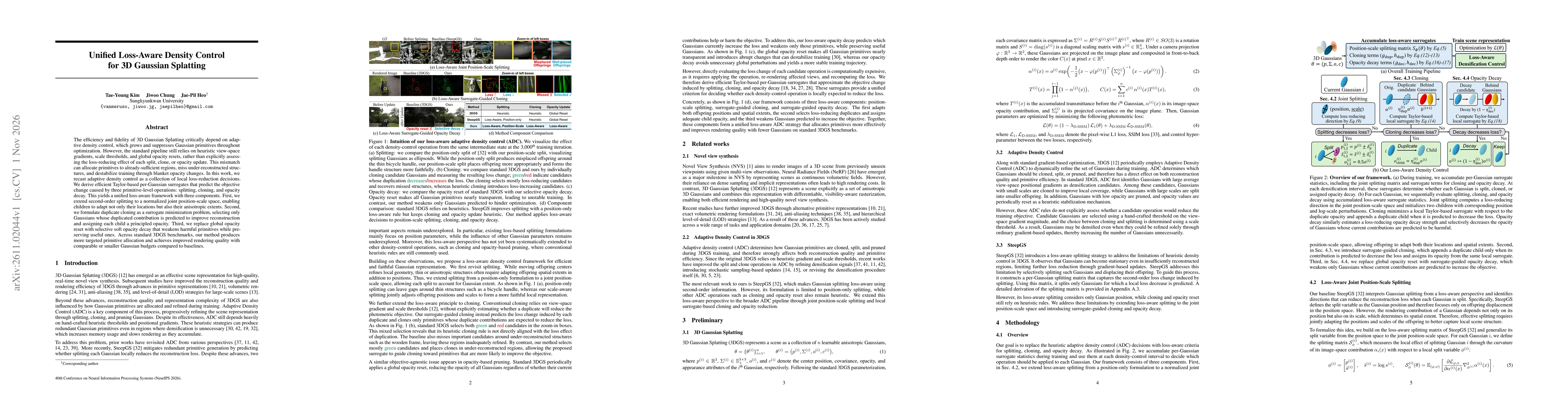
- Qualitative visualizations show that joint position‑scale splitting better captures thin structures, surrogate‑guided cloning recovers under‑reconstructed regions, and selective opacity decay stabilizes training.
LimitationsWhere the findings need caution
- Current loss‑aware formulations focus primarily on position and scale parameters, leaving the influence of other Gaussian attributes underexplored.
- The framework is evaluated only on standard 3DGS benchmarks, and its generalization to more diverse scenes or real‑world datasets remains untested.
MethodologyHow the work was done
We recast adaptive density control as a set of local loss‑reduction decisions and derive efficient Taylor‑based per‑Gaussian surrogates that predict the objective change caused by splitting, cloning, and opacity decay. The framework includes (1) second‑order splitting extended to a normalized joint position‑scale space, (2) surrogate‑guided duplicate cloning formulated as a minimization problem with principled opacity assignment, and (3) selective soft opacity decay that weakens only harmful primitives.
SignificanceWhy the work matters
By explicitly estimating the loss‑reduction effect of each density‑control operation, the approach eliminates redundant primitives and improves both efficiency and fidelity of 3D Gaussian splatting, addressing a key limitation of prior heuristic‑based pipelines.
Technical contributionsWhat the work introduces
A unified loss‑aware adaptive density control framework that integrates Taylor‑based surrogate predictions for splitting, cloning, and opacity decay, enabling targeted primitive allocation and improved rendering performance.
NoveltyHow it differs from prior work
First work to jointly apply loss‑aware decision making to splitting, cloning, and opacity updates in 3D Gaussian splatting, introducing a normalized joint position‑scale splitting and surrogate‑guided cloning with principled opacity assignment.
Future workQuestions that remain
- Extend the loss‑aware paradigm to incorporate additional Gaussian parameters such as orientation and color.
- Investigate adaptive strategies for other density‑control operations beyond splitting, cloning, and opacity decay.
- Validate the method on larger‑scale and more varied datasets to assess robustness and scalability.
Discussion 0