UniSwap: Streaming Audio-Visual Identity Swapping for Talking Videos
Abstract
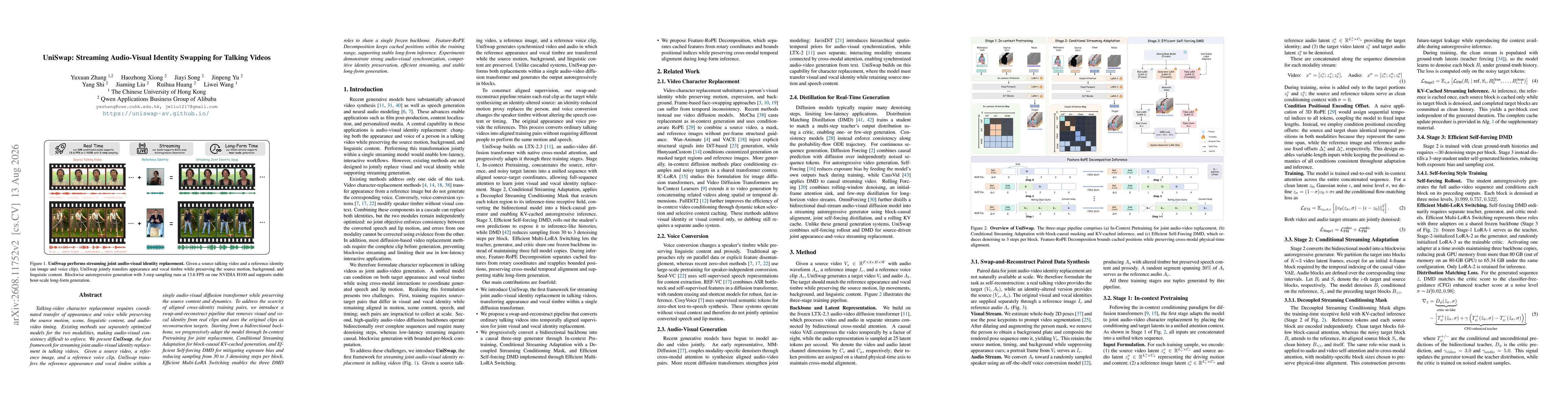
Talking-video character replacement requires coordinated transfer of appearance and voice while preserving the source motion, scene, linguistic content, and audio-video timing. Existing methods use separately optimized models for the two modalities, making audio-visual consistency difficult to enforce. We present UniSwap, the first framework for streaming joint audio-visual identity replacement in talking videos. Given a source video, a reference image, and a reference voice clip, UniSwap transfers the reference appearance and vocal timbre within a single audio-visual diffusion transformer while preserving the source content and dynamics. To address the scarcity of aligned cross-identity training pairs, we introduce a swap-and-reconstruct pipeline that removes visual and vocal identity from real clips and uses the original clips as reconstruction targets. Starting from a bidirectional backbone, we progressively adapt the model through In-context Pretraining for joint replacement, Conditional Streaming Adaptation for block-causal KV-cached generation, and Efficient Self-forcing DMD for mitigating exposure bias and reducing sampling from 30 to 3 denoising steps per block. Efficient Multi-LoRA Switching enables the three DMD roles to share a single frozen backbone. Feature-RoPE Decomposition keeps cached positions within the training range, supporting stable long-form inference. Experiments demonstrate strong audio-visual synchronization, competitive identity preservation, efficient streaming, and stable long-form generation.
Analysis
AI-generated · verify against the original paper
Generated Aug 16, 2026ResultsWhat the authors found
- Experiments show strong audio-visual synchronization and competitive identity preservation while enabling efficient streaming and stable long-form generation.
- Block-wise autoregressive generation with 3-step sampling achieves near-real-time performance (e.g., 13.6 FPS on 1 H100) and supports hour-scale generation.
- The framework maintains alignment between appearance and timbre within a single diffusion transformer, reducing latency without sacrificing quality.
LimitationsWhere the findings need caution
- Reliance on swap-and-reconstruct supervision may still imperfectly remove cross-identity cues in highly similar identities.
- Performance claims are reported under specific hardware and sampling settings; real-world variability may affect streaming throughput and stability.
- Long-form generation quality may degrade with extremely long videos due to drift in temporal consistency despite Feature-RoPE Decomposition.
MethodologyHow the work was done
UniSwap introduces a streaming joint audio-visual identity replacement framework built on a single audio-visual diffusion transformer. It uses a swap-and-reconstruct training pipeline to create aligned supervision from real clips by removing visual and vocal identity and using the original clips as targets. The training progresses through three stages: In-context Pretraining for joint replacement, Conditional Streaming Adaptation for block-causal KV-cached generation, and Efficient Self-forcing DMD with Efficient Multi-LoRA Switching to share a frozen backbone across roles. Feature-RoPE Decomposition is employed to maintain temporal alignment and support long-form inference during streaming.
SignificanceWhy the work matters
First framework to enable streaming joint audio-visual identity replacement in talking videos, addressing the challenge of coordinating appearance and voice within a unified model and supporting long-form, low-latency generation for interactive workflows.
Technical contributionsWhat the work introduces
A unified, streaming-ready audio-visual diffusion transformer with a swap-and-reconstruct training pipeline, three-stage progressive adaptation (In-context Pretraining, Conditional Streaming Adaptation, Efficient Self-forcing DMD), Efficient Multi-LoRA Switching for sharing a frozen backbone, and Feature-RoPE Decomposition to stabilize long-form inference.
NoveltyHow it differs from prior work
First end-to-end framework for streaming joint audio-visual identity replacement in talking videos, achieving coordinated appearance and vocal timbre transfer within a single model and enabling block-causal, KV-cached generation for low-latency long-form outputs.
Future workQuestions that remain
- Explore broader cross-domain generalization to unseen languages and accents while maintaining alignment.
- Investigate robustness to occlusions, rapid lighting changes, and complex backgrounds in streaming scenarios.
- Extend the approach to multi-identity replacement and user-controlled trade-offs between identity fidelity and preservation of content.
Discussion 0