Unsupervised Multimodal Intent Discovery via MLLM-Guided Concept Generation and Semantic Propagation
Abstract
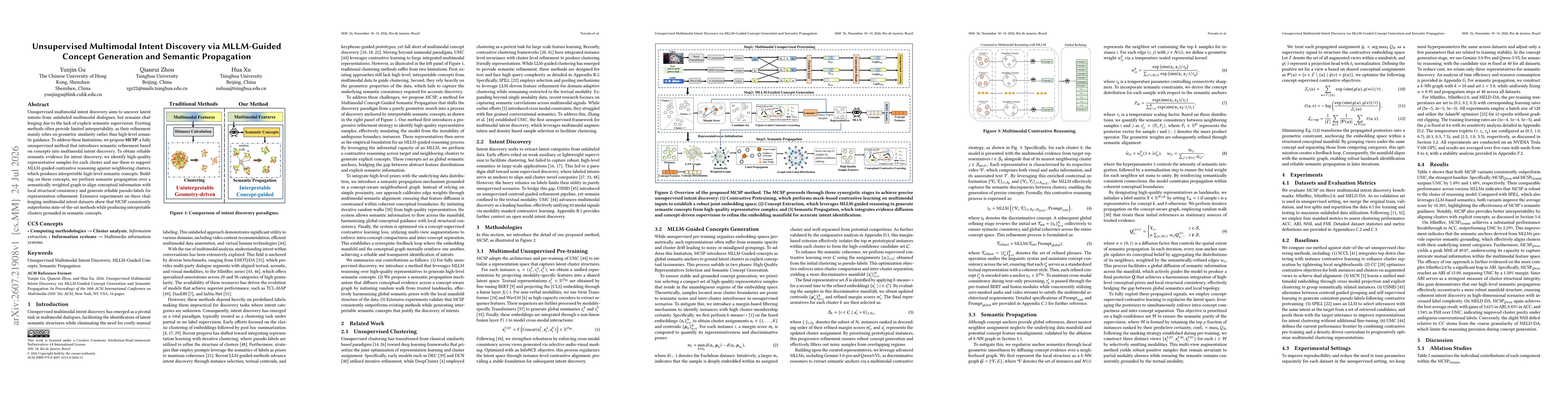
Unsupervised multimodal intent discovery aims to uncover latent intents from unlabeled multimodal dialogues, but remains challenging due to the lack of explicit semantic supervision. Existing methods often provide limited interpretability, as their refinement mainly relies on geometric similarity rather than high-level semantic guidance. To address these limitations, we propose MCSP, a fully unsupervised method that introduces semantic refinement based on concepts into multimodal intent discovery. To obtain reliable semantic evidence for intent discovery, we identify high-quality representative samples for each cluster and use them to support MLLM-guided contrastive reasoning against neighboring clusters, which produces interpretable high-level semantic concepts. Building on these concepts, we perform semantic propagation over a semantically weighted graph to align conceptual information with local structural consistency and generate reliable pseudo-labels for representation refinement. Extensive experiments on three challenging multimodal intent datasets show that MCSP consistently outperforms state-of-the-art methods while producing interpretable clusters grounded in semantic concepts.
AI Key Findings
Get AI-generated insights about this paper's methodology, results, significance, and more — available when analysis has been generated.
Discussion 0