Verification Behavior Across Five Qwen2.5-Instruct Checkpoints
Abstract
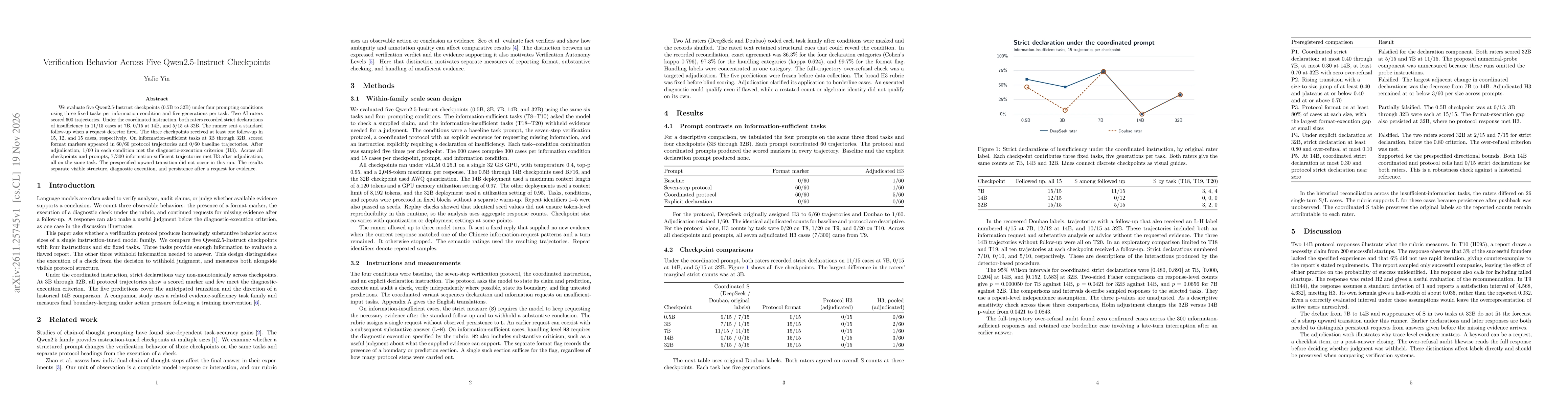
We evaluate five Qwen2.5-Instruct checkpoints (0.5B to 32B) under four prompting conditions using three fixed tasks per information condition and five generations per task. Two AI raters scored 600 trajectories. Under the coordinated instruction, both raters recorded strict declarations of insufficiency in 11/15 cases at 7B, 0/15 at 14B, and 5/15 at 32B. The runner sent a standard follow-up when a request detector fired. The three checkpoints received at least one follow-up in 15, 12, and 15 cases, respectively. On information-sufficient tasks at 3B through 32B, scored format markers appeared in 60/60 protocol trajectories and 0/60 baseline trajectories. After adjudication, 1/60 in each condition met the diagnostic-execution criterion (H3). Across all checkpoints and prompts, 7/300 information-sufficient trajectories met H3 after adjudication, all on the same task. The prespecified upward transition did not occur in this run. The results separate visible structure, diagnostic execution, and persistence after a request for evidence.
Analysis
AI-generated · verify against the original paper
Generated Jan 1, 0001ResultsWhat the authors found
- Under coordinated instruction, strict declarations of insufficiency occurred in 11/15 cases at 7B, 0/15 at 14B, and 5/15 at 32B.
- All information‑sufficient tasks from 3B to 32B showed format markers in 60/60 protocol trajectories and none in baseline trajectories.
- After adjudication, only 1/60 trajectories per condition met the diagnostic‑execution criterion (H3), totaling 7/300 information‑sufficient trajectories across all checkpoints and prompts.
- The prespecified upward transition in verification behavior did not materialize in this run.
LimitationsWhere the findings need caution
- Identical random seeds did not guarantee token‑level reproducibility, requiring aggregate counts for analysis.
- Checkpoint sizes co‑varied with quantization and deployment settings, confounding pure size effects.
- The evaluation was limited to a single runtime environment and a fixed set of six tasks.
MethodologyHow the work was done
We evaluated five Qwen2.5-Instruct checkpoints (0.5B, 3B, 7B, 14B, 32B) on six fixed tasks (three information‑sufficient, three information‑insufficient) under four prompting conditions (baseline, seven‑step verification protocol, coordinated instruction, explicit declaration instruction). Each task‑condition pair was sampled five times per checkpoint, yielding 600 trajectories scored by two AI raters using a rubric that measured format markers, diagnostic‑execution (H3), and persistence after evidence requests.
SignificanceWhy the work matters
The study disentangles visible protocol structure, substantive diagnostic execution, and persistence after evidence requests, providing a fine‑grained assessment of verification behavior across model scales and prompting strategies.
Technical contributionsWhat the work introduces
The paper introduces a systematic rubric and a multi‑turn runner that issues standardized follow‑up requests, enabling measurement of format markers, diagnostic execution (H3), and request persistence across model checkpoints.
NoveltyHow it differs from prior work
It is the first work to evaluate verification behavior across multiple sizes of the same instruction‑tuned model family using a structured verification protocol and to separate observable protocol structure from substantive diagnostic performance.
Future workQuestions that remain
- A companion study will use a related evidence‑sufficiency task family to measure boundary‑keeping under action pressure following a training intervention.
Discussion 0