Verify then Steer: Progress Hallucination-Aware Recovery for Continuous Vision-and-Language Navigation
Abstract
Vision-and-Language Navigation (VLN) requires an agent to follow language instructions to reach a target in an unseen 3D environment. However, existing methods still struggle to recover from route deviations at test time. We investigate this limitation through the lens of instruction progress, and trace it to a phenomenon we term progress hallucination: agents misinterpret off-route observations as evidence of task progress, causing their internal instruction progress to advance beyond the actual task stage and hindering recovery based on earlier sub-instructions. To address this failure mode, we propose PHAR (Progress Hallucination-Aware Recovery), a test-time recovery framework following a verify-then-steer paradigm. The verifier examines residual-stream representations of the Vision-Language Model (VLM) to identify mismatch of cross-modal evidence along the trajectories, and uses split conformal calibration to control false alarms. When an alarm is raised, the steering module uses a contextual bandit to adaptively select the rewind extent of instruction progress for online recovery. Through extensive experiments on R2R-CE and RxR-CE, our framework enhances the reliability of multiple state-of-the-art vision-language navigation methods at test time.
Analysis
AI-generated · verify against the original paper
Generated Jan 1, 0001ResultsWhat the authors found
- Extensive experiments on R2R‑CE and RxR‑CE show that PHAR consistently improves the reliability of multiple state‑of‑the‑art VLN methods at test time.
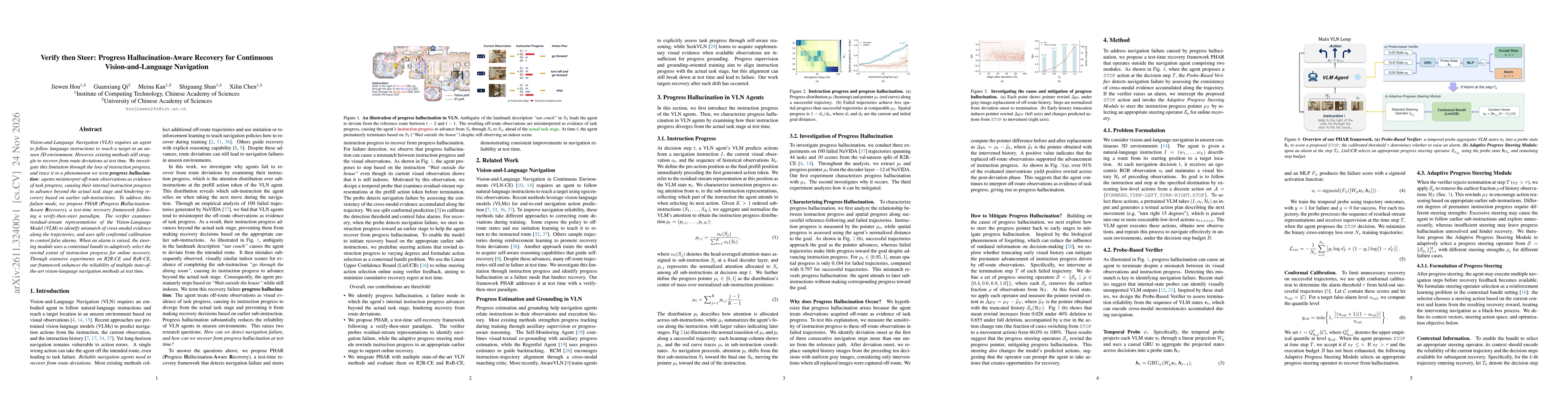
- Qualitative examples demonstrate that PHAR can detect premature stops (e.g., t=0.9545) and steer the agent to correctly complete missed sub‑instructions, reducing goal distance from 10.48 m to 0.33 m in a recovery attempt.
- Ablation studies on steering strength (ρ) reveal that appropriate steering (e.g., ρ=0.8) redirects attention to earlier sub‑instructions and enables successful recovery, whereas overly strong steering (ρ=1.0) leads to failure.
MethodologyHow the work was done
PHAR is a test-time recovery framework that follows a verify‑then‑steer paradigm. A verifier probes residual‑stream representations of a pre‑trained vision‑language model to detect mismatches between cross‑modal evidence and instruction progress, using split conformal calibration to control false alarms. When a failure is detected, a steering module formulates the selection of how far to rewind instruction progress as a contextual bandit problem and applies LinUCB to adaptively choose the rewind extent for online recovery.
SignificanceWhy the work matters
The work identifies and mitigates the progress hallucination failure mode in VLN, enabling agents to recover from off‑route deviations without retraining, thereby enhancing the robustness and practical applicability of vision‑language navigation systems.
Technical contributionsWhat the work introduces
The introduction of a verification mechanism based on residual‑stream representations combined with split conformal calibration, and an adaptive progress‑steering module formulated as a contextual bandit, constitute a novel test‑time self‑recovery framework for VLN.
NoveltyHow it differs from prior work
PHAR is the first framework to detect progress hallucination via cross‑modal evidence mismatch in residual streams and to apply a verify‑then‑steer strategy with contextual bandit‑based adaptive rewinding for online navigation recovery.
Discussion 0