VISOLO: Grid-Based Space-Time Aggregation for Efficient Online Video Instance Segmentation
VISOLO proposes a single-stage framework for online video instance segmentation that efficiently utilizes information from previous frames, achieving state-of-the-art accuracy and speed on two popular datasets.
Abstract
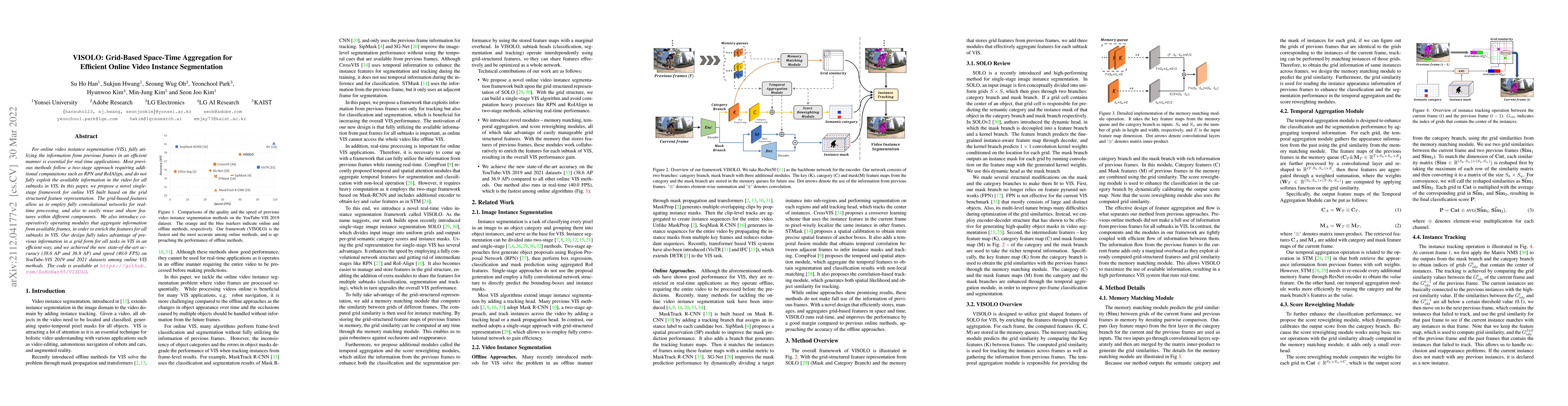
For online video instance segmentation (VIS), fully utilizing the information from previous frames in an efficient manner is essential for real-time applications. Most previous methods follow a two-stage approach requiring additional computations such as RPN and RoIAlign, and do not fully exploit the available information in the video for all subtasks in VIS. In this paper, we propose a novel single-stage framework for online VIS built based on the grid structured feature representation. The grid-based features allow us to employ fully convolutional networks for real-time processing, and also to easily reuse and share features within different components. We also introduce cooperatively operating modules that aggregate information from available frames, in order to enrich the features for all subtasks in VIS. Our design fully takes advantage of previous information in a grid form for all tasks in VIS in an efficient way, and we achieved the new state-of-the-art accuracy (38.6 AP and 36.9 AP) and speed (40.0 FPS) on YouTube-VIS 2019 and 2021 datasets among online VIS methods. The code is available at https://github.com/SuHoHan95/VISOLO.
AI Key Findings
Get AI-generated insights about this paper's methodology, results, significance, and more — available when analysis has been generated.
Discussion 0