Visual Geometry Foundation-Aware Gaussians for Single-Frame Surround-View Driving Reconstruction
The paper introduces VGGD, a 3D Gaussian splatting framework that uses pretrained visual-geometry priors to improve single-frame surround-view reconstruction for driving. By separating geometry and appearance, stabilizing early learning, and using a hybrid pixel–volume decoder, VGGD achieves better rendering quality and geometric consistency on the nuScenes single-frame benchmark.
Abstract
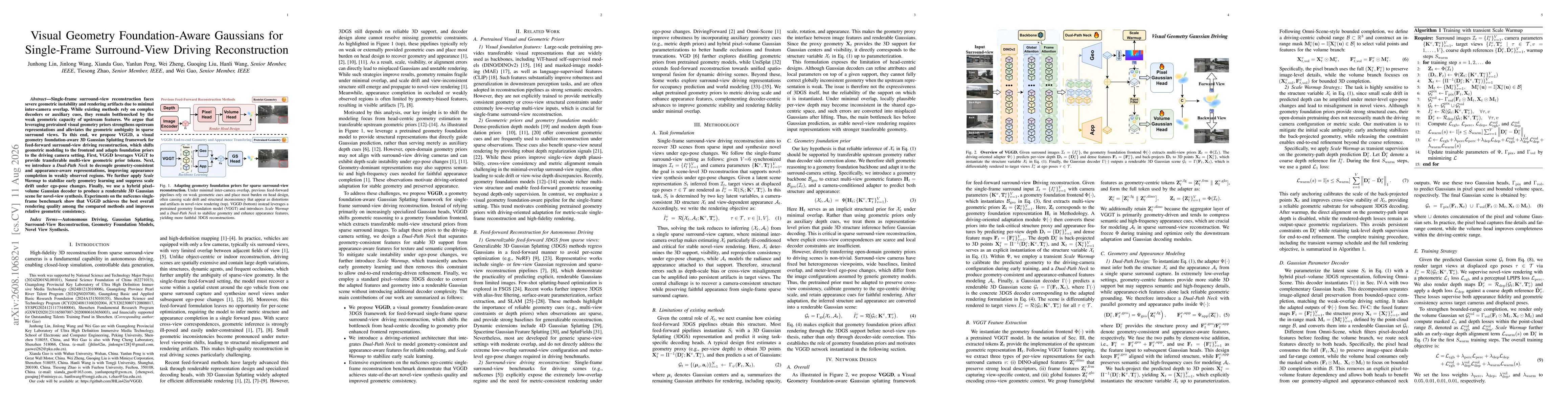
Single-frame surround-view reconstruction faces severe geometric instability and rendering artifacts due to minimal inter-camera overlap. While existing methods rely on complex decoders or auxiliary cues, they remain bottlenecked by the weak geometric capacity of upstream features. We argue that leveraging pretrained visual geometry priors strengthens upstream representations and alleviates the geometric ambiguity in sparse surround views. To this end, we propose VGGD, a visual geometry foundation-aware 3D Gaussian Splatting framework for feed-forward surround-view driving reconstruction, which shifts geometric modeling to the frontend and adapts foundation priors to the driving camera setting. First, VGGD leverages VGGT to provide transferable multi-view geometric prior tokens. Next, we introduce a Dual-Path Neck to decouple geometry-consistent and appearance-aware representations, improving appearance completion in weakly observed regions. We further apply Scale Warmup to stabilize early geometry learning and suppress scale drift under ego-pose changes. Finally, we use a hybrid pixel--volume Gaussian decoder to produce a renderable 3D Gaussian scene for novel-view synthesis. Experiments on the nuScenes single-frame benchmark show that VGGD achieves the best overall rendering quality among the compared methods and improves relative geometric consistency.
Analysis
AI-generated · verify against the original paper
Generated Aug 13, 2026ResultsWhat the authors found
- On nuScenes single-frame benchmark, VGGD achieves state-of-the-art novel-view synthesis quality and improved geometric consistency compared to strong baselines.
- Ablation studies show Scale Warmup stabilizes early geometry learning and reduces scale drift under ego-pose changes, while the Dual-Path Neck improves geometry-appearance decoupling for robust rendering.
- The combination of geometry-prior supervision and frontend geometry modeling yields more faithful 3D Gaussian reconstructions and clearer depth mappings across challenging weakly observed regions.
LimitationsWhere the findings need caution
- The approach focuses on static single-frame reconstruction and does not model dynamic scene elements or motion dynamics.
- Reliance on pretrained geometry priors may limit performance in environments with unseen geometric configurations or nonstandard camera setups.
MethodologyHow the work was done
VGGD is a visual geometry foundation-aware 3D Gaussian Splatting framework for single-frame surround-view driving reconstruction that shifts geometric modeling to the frontend by leveraging pretrained geometry priors (VGGT) and introduces driving-oriented adaptations (Dual-Path Neck and Scale Warmup) plus a hybrid pixel–volume 3D Gaussian decoder to render novel views.
SignificanceWhy the work matters
Demonstrates that transferring pretrained geometric priors to the frontend and decoupling geometry from appearance can substantially improve both rendering quality and cross-view geometric consistency in extreme low-overlap surround-view driving scenarios, offering a scalable alternative to decoder-centric designs.
Technical contributionsWhat the work introduces
Introduction of VGGD: a geometry foundation-aware 3D Gaussian Splatting pipeline for single-frame surround-view reconstruction that (i) integrates VGGT-based geometric priors, (ii) employs a Dual-Path Neck to separate geometry-consistent and appearance-aware features, (iii) applies Scale Warmup to stabilize early geometry learning, and (iv) uses a hybrid pixel–volume 3DGS decoder for renderable Gaussian scenes.
NoveltyHow it differs from prior work
Shifts geometric reasoning from the decoder to geometry-prior-informed frontend, adapts geometry foundation models to driving camera configurations, and demonstrates a driving-oriented architecture that balances geometry stability with high-fidelity appearance in sparse surround-view reconstruction.
Future workQuestions that remain
- Extend VGGD to incorporate dynamic scene modeling to handle moving agents and temporal consistency.
- Explore adaptive geometry priors that can better adapt to diverse driving environments and camera configurations.
- Investigate end-to-end training with dynamics-aware loss terms and temporal fusion for improved stability over sequences.
Discussion 0