VSRo-200: A Romanian Visual Speech Recognition Dataset for Studying Supervision and Multimodal Robustness
Abstract
We introduce VSRo-200, the first large-scale dataset for visual speech recognition (lip reading) in Romanian, comprising 200 hours of real-world podcast videos. All samples are annotated with pseudo-labels generated by a fine-tuned Romanian ASR model, while a subset of 100 hours is additionally transcribed by humans, enabling controlled analysis of supervision quality under a unified framework. Building on this dataset, we establish a benchmark for visual speech recognition in low-resource settings. We systematically study the impact of supervision quality, showing that while human annotations provide better performance at fixed data scales, pseudo-labels enable continued improvements through scalability. We further evaluate robustness under domain shift using curated out-of-distribution (OOD) test sets, and analyze audio-visual speech recognition (AVSR) under noisy conditions, where multimodal fusion significantly improves robustness compared to audio-only models. Finally, we demonstrate that representations learned on VSRo-200 transfer effectively to the LRRo benchmark for isolated word recognition, substantially outperforming previously reported results. Overall, VSRo-200 provides a new testbed for studying supervision, domain generalization, and multimodal fusion in low-resource visual speech recognition.
Analysis
AI-generated · verify against the original paper
Generated Jul 11, 2026ResultsWhat the authors found
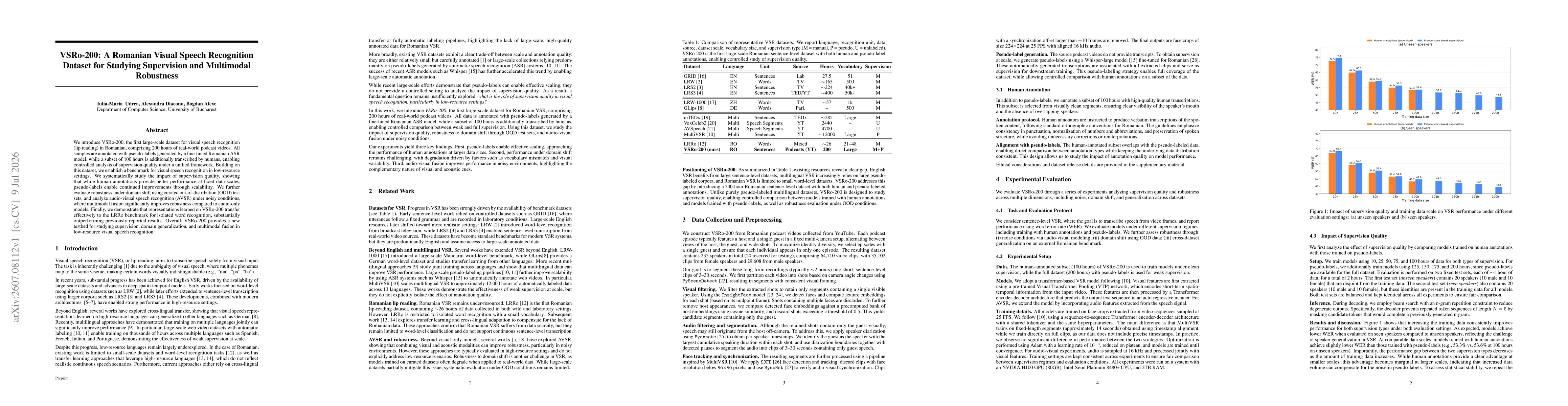
- Pseudo-labels enable effective scaling and approach human-annotation performance at larger data scales, highlighting the value of weak supervision for growth.
- Domain shift remains challenging, with degradation driven by vocabulary mismatch and visual variability, indicating limited generalization across distributions.
- Audio-visual fusion significantly improves robustness in noisy conditions compared to audio-only models, underscoring the complementary benefits of visual cues.
- Representations learned on VSRo-200 transfer effectively to the LRRo benchmark for isolated word recognition, outperforming prior results.
LimitationsWhere the findings need caution
- Evaluation is constrained to curated OOD test sets which may not capture full real-world variability.
- Performance gaps under domain shift suggest that current models may still overfit to vocabulary and visual patterns in the source domain.
MethodologyHow the work was done
We introduce VSRo-200, a Romanian VSR dataset with 200 hours of real-world podcast videos annotated with pseudo-labels from a Romanian ASR model and a 100-hour subset human-transcribed for controlled supervision analysis. We establish a low-resource VSR benchmark and systematically study supervision quality, domain shift via curated OOD test sets, and AVSR under noisy conditions using dynamic modality fusion and ablations to quantify robustness and scalability.
SignificanceWhy the work matters
The dataset provides a controlled framework to study supervision quality, domain generalization, and multimodal fusion in low-resource VSR, and demonstrates practical transferability to related Romanian lip-reading tasks, informing design of scalable and robust VSR systems.
Technical contributionsWhat the work introduces
A new large-scale Romanian VSR dataset with mixed supervision (pseudo-labels plus a human-annotated subset), a benchmark for low-resource VSR evaluating supervision quality, domain shift, and AVSR robustness, and transferability results to a related isolated word recognition task.
NoveltyHow it differs from prior work
First large-scale Romanian lip-reading dataset with explicit comparison between pseudo-label supervision and human transcription within a unified framework, plus systematic study of domain shift and multimodal fusion in low-resource VSR.
Future workQuestions that remain
- Explore normalization or augmentation strategies to mitigate demographic and visual biases observed in training data.
- Investigate more sophisticated fusion strategies or modality reliability estimation to further enhance AVSR under adverse conditions.
- Extend analyses to additional low-resource languages and multi-domain corpora to assess generality of supervision quality effects.
Discussion 0