This study uses GROND multiband observations to characterize the hot Jupiter WASP-4b, determining its radius and orbital parameters, and finds no significant transit timing variations (TTVs). The derived planetary radius is Rp = 1.413±0.020 RJup, with a new ephemeris period P = 1.33823144±0.00000032 days.
Abstract
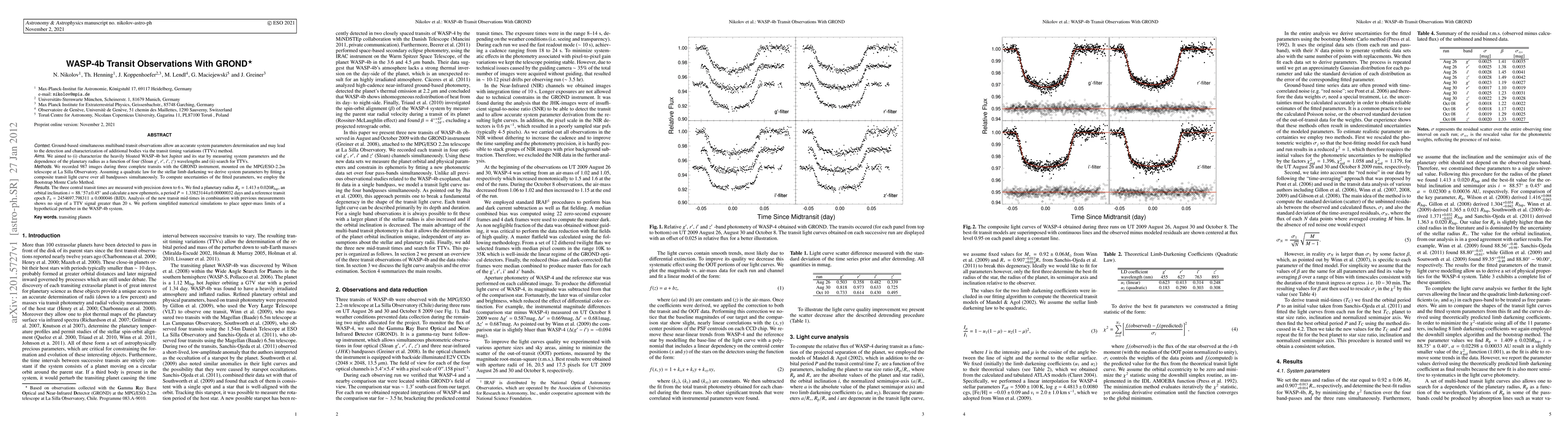
Ground-based simultaneous multiband transit observations allow an accurate system parameters determination and may lead to the detection and characterization of additional bodies via the transit timing variations (TTVs) method. We aimed to (i) characterize the heavily bloated WASP-4b hot Jupiter and its star by measuring system parameters and the dependence of the planetary radius as a function of four (Sloan g', r', i', z') wavelengths and (ii) search for TTVs. We recorded 987 images during three complete transits with the GROND instrument, mounted on the MPG/ESO-2.2m telescope at La Silla Observatory. Assuming a quadratic law for the stellar limb darkening we derive system parameters by fitting a composite transit light curve over all bandpasses simultaneously. To compute uncertainties of the fitted parameters, we employ the Bootstrap Monte Carlo Method. The three central transit times are measured with precision down to 6 s. We find a planetary radius Rp = 1.413+/-0.020 RJup, an orbital inclination i = 88deg57'+/-0.45deg and calculate a new ephemeris, a period P = 1.33823144+/-0.00000032days and a reference transit epoch T0 = 2454697.798311+/-0.000046 (BJD). Analysis of the new transit mid-times in combination with previous measurements shows no sign of a TTV signal greater than 20s. We perform simplified numerical simulations to place upper-mass limits of a hypothetical perturber in the WASP-4b system.
AI Key Findings
Get AI-generated insights about this paper's methodology, results, significance, and more — available when analysis has been generated.
Discussion 0