Abstract
Camera object detectors lose recall in rain, fog, snow and sand, and the confidence threshold at which a detector is deployed decides how many objects it misses and how many false alarms it raises. We study how a frozen detector should make this decision in adverse weather. We first reproduce SeqCRC, a conformal object detector whose first step calibrates the confidence threshold by conformal risk control (CRC), and use that step, calibrated separately in each weather condition, as our baseline. With YOLOv8x it keeps the held-out miss fraction within a 20% budget in every DAWN weather bin, where a single global threshold fails in fog, but the false alarms it needs are an output rather than a choice: from 1.6 to 117 per image across DAWN and BDD100K conditions. We then propose a calibrated trade-off dial. One setting, $λ$, the number of false alarms accepted to avoid one missed object, selects the expected-cost-optimal decision rule: either one score threshold, or a per-detection rule that keeps a box when its calibrated probability of being a real object, estimated by gradient-boosted trees from the detector's own per-box outputs, is at least $1/(1+λ)$. F-score preferences map onto the same dial, and CRC applied to $λ$ itself is planned to restore a per-condition miss guarantee. The dial is fitted once on BDD100K train and graded only on BDD100K val and DAWN.
Analysis
AI-generated · verify against the original paper
Generated Jan 1, 0001ResultsWhat the authors found
- The per‑weather CRC baseline kept the held‑out miss fraction within a 20% budget for every DAWN weather bin, while the number of false alarms ranged from 1.6 to 117 per image.
- The λ trade‑off dial selects the expected‑cost‑optimal decision rule, either a single score threshold or a per‑detection cut‑off at calibrated probability ≥ 1/(1+λ).
- F‑score preferences map onto the same λ dial, demonstrating its flexibility across performance metrics.
LimitationsWhere the findings need caution
- False‑alarm counts vary widely across conditions, indicating limited control over false positives.
- The per‑condition miss guarantee is only planned (via CRC on λ) and not yet realized.
- Calibration assumes exchangeability of training and test distributions, which may be violated under weather shift.
MethodologyHow the work was done
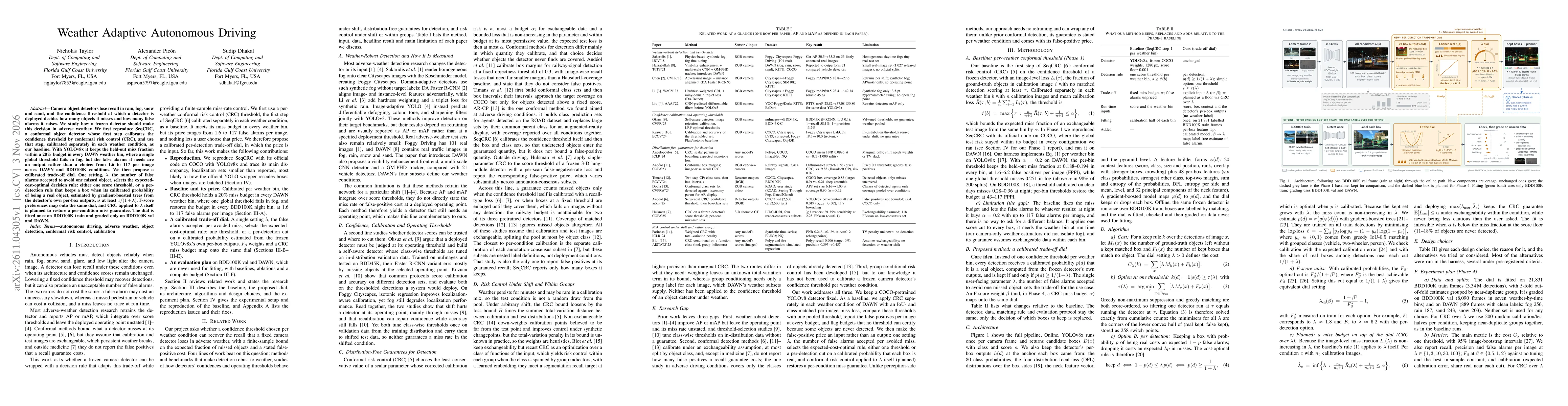
The authors reproduced the SeqCRC conformal object detector using YOLOv8x, calibrating confidence thresholds separately for each weather condition (DAWN bins) via conformal risk control (CRC). They then introduced a calibrated trade‑off dial parameter λ, representing the number of false alarms accepted to avoid one missed object, and used gradient‑boosted trees to estimate per‑box calibrated probabilities, applying a decision rule based on λ. Experiments were conducted on BDD100K train/val and the DAWN dataset, with the baseline calibrated per‑weather and the dial fitted on training data only.
SignificanceWhy the work matters
This work provides a practical framework for adapting frozen camera detectors to adverse weather by jointly controlling miss rates and false‑alarm costs, enabling safer autonomous driving without retraining the detector.
Technical contributionsWhat the work introduces
Reproduction of SeqCRC with YOLOv8x, identification and fixing of localization discrepancies, establishment of a per‑weather CRC baseline, and the introduction of a λ‑based calibrated trade‑off dial using gradient‑boosted tree probability estimates for per‑detection decisions.
NoveltyHow it differs from prior work
First to integrate a cost‑sensitive λ trade‑off dial with conformal risk control for frozen detectors, providing weather‑adaptive per‑detection thresholding without retraining.
Future workQuestions that remain
- Apply CRC to the λ parameter to restore per‑condition miss‑rate guarantees.
- Extend evaluation to additional datasets and real‑world test scenarios.
- Reduce computational overhead of calibration and explore faster approximations.
Discussion 0