What Do Co-Folding Models Learn? Insights from Enhanced Transition Path Sampling
Abstract
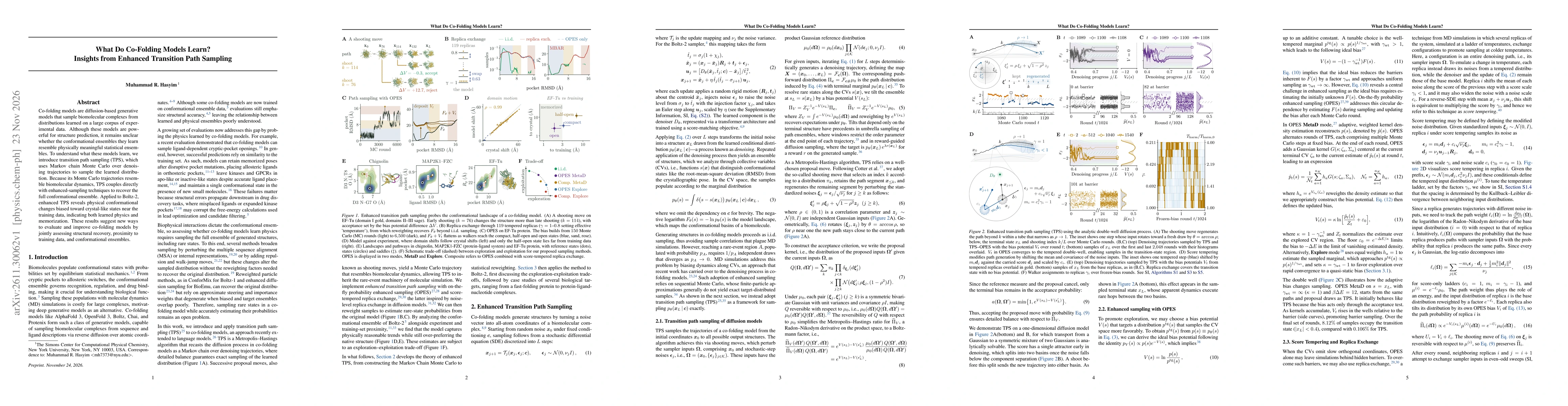
Co-folding models are diffusion-based generative models that sample biomolecular complexes from distributions learned on a large corpus of experimental data. Although these models are powerful for structure prediction, it remains unclear whether the conformational ensembles they learn resemble physically meaningful statistical ensembles. To understand what these models learn, we introduce transition path sampling (TPS), which uses Markov chain Monte Carlo over denoising trajectories to sample the learned distribution. Because its Monte Carlo trajectories resemble biomolecular dynamics, TPS couples directly with enhanced-sampling techniques to recover the full conformational ensemble. Applied to Boltz-2, enhanced TPS reveals physical conformational changes biased toward crystal-like states near the training data, indicating both learned physics and memorization. These results suggest new ways to evaluate and improve co-folding models by jointly assessing structural recovery, proximity to training data, and conformational ensembles.
AI Key Findings
Get AI-generated insights about this paper's methodology, results, significance, and more — available when analysis has been generated.
Discussion 0