What the Middleman Delivers: Answer Behavior, Tool Permissions, and Billed Usage in LLM API Relays
Abstract
Third-party application programming interface (API) relays offer access to large language models (LLMs), often at lower prices. Users depend on these services for model quality, instruction compliance, and accurate billing. However, existing studies leave unclear whether relays meet these expectations together. We test 20 relays offering GPT-6 Astra and Claude Opus 5. First, we compare answers to knowledge questions with batch-matched official responses. In our first-round sample, the analysis flags 7/10 low-price and 2/10 same- or higher-price relays for behavioral differences. On retesting 35 pairs, seven gain or lose a flag under the original rules, and six under matched correction families. Because answer comparisons cannot reveal every delivery problem, we examine returned content and tool permissions. No injection is confirmed in 3,332 screened responses to a fixed, non-adversarial code and setup workload, yet four relays return tool calls despite instructions disabling them in the first round. Finally, to connect reported usage to actual costs, we compare input-token counts with official references and check balances. For identical requests, five relays report 4,200 to 60,000 more input tokens than the official API. Where balances are available (six services), charges follow reported usage at listed prices, including extra reported input tokens at one service. Our study shows that advertised models and prices are insufficient to judge relay reliability. It identifies unexplained billed token quantities and tool-permission violations as risks and shows why service evaluations need repeated measurements.
Analysis
AI-generated · verify against the original paper
Generated Jan 1, 0001ResultsWhat the authors found
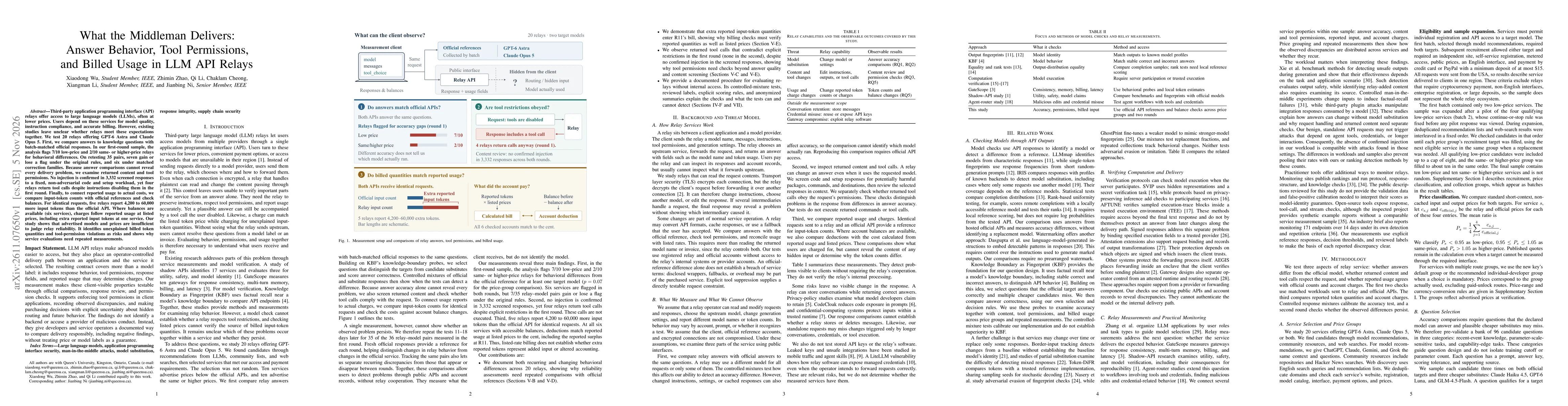
- In the first round, 7 of 10 low‑price relays and 2 of 10 same‑or‑higher‑price relays were flagged for answer‑behavior differences compared to official APIs.
- Four relays returned tool calls despite explicit instructions disabling tools, though no code injection was observed.
- Five relays reported 4,200 to 60,000 extra input tokens for identical requests relative to the official API.
- For the six services where balances were available, charges matched reported usage at listed prices, including the extra reported tokens for one service.
- Repeated measurements showed that some relay‑model pairs gained or lost flags, highlighting the need for ongoing evaluation.
LimitationsWhere the findings need caution
- The selection of relays was not random, focusing on services that met specific access and payment criteria.
- The evaluation covered only two target models (GPT‑6 Astra and Claude Opus 5).
- The study examined a limited set of 20 relays, which may not represent the broader ecosystem.
MethodologyHow the work was done
The authors built a measurement client that sent identical requests to 20 third‑party LLM API relays and to the official GPT‑6 Astra and Claude Opus 5 APIs. They compared relay answers to batch‑matched official responses, screened 3,332 returned contents for tool‑call violations, checked tool permissions, and reconciled reported input‑token counts with official references and account balances. Tests were repeated after 11–18 days for 35 relay‑model pairs to capture recurring and changing behavior.
SignificanceWhy the work matters
The study demonstrates that advertised model labels and prices are insufficient to assess relay reliability, revealing hidden risks such as unexplained billed token quantities and tool‑permission violations, and underscores the importance of repeated, multi‑dimensional measurements for trustworthy LLM API usage.
Technical contributionsWhat the work introduces
The paper provides a comprehensive measurement framework that jointly assesses answer correctness, tool‑permission compliance, and billing accuracy for LLM API relays, and documents both recurring and changing behavioral differences across multiple services.
NoveltyHow it differs from prior work
It is the first work to simultaneously evaluate answer behavior, tool permission enforcement, and billed usage in LLM API relays using repeated measurements to capture both persistent and transient issues.
Discussion 0