When Automata Meet Streams: Temporal Logic Compilation for Stream-Based Robotics Task and Motion Planning
Abstract
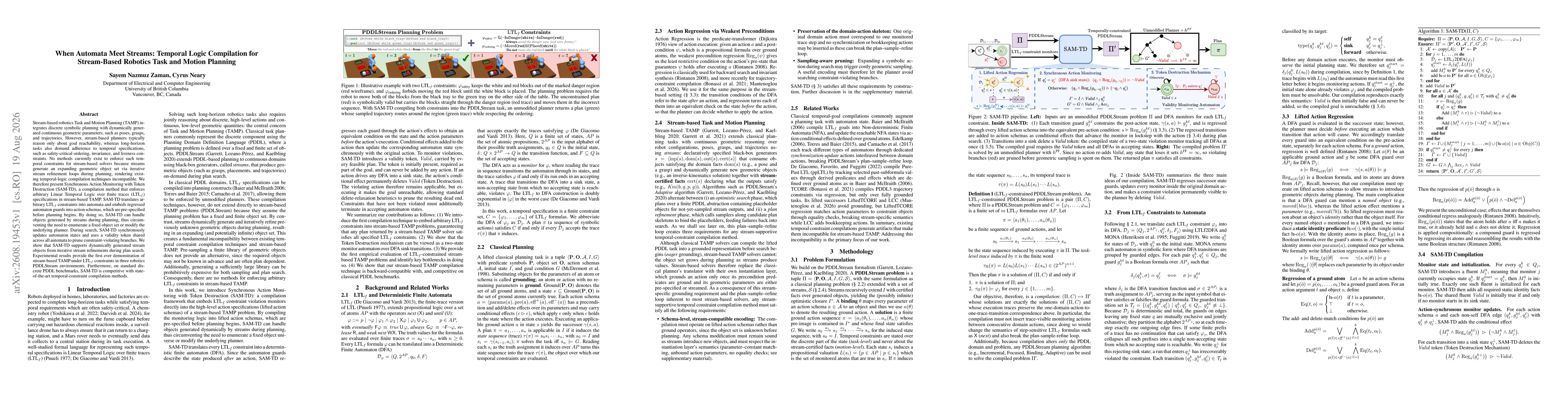
Stream-based robotics Task and Motion Planning (TAMP) integrates discrete symbolic planning with dynamically generated continuous geometric parameters, such as poses, grasps, and trajectories. However, stream-based planners typically reason only about goal reachability, whereas long-horizon tasks also demand adherence to temporal specifications, such as safety-critical ordering, invariance, and liveness constraints. No methods currently exist to enforce such temporal constraints for stream-based solvers because streams generate an expanding geometric object set via iterative stream refinement loops during planning, rendering existing temporal-logic compilation techniques incompatible. We therefore present Synchronous Action Monitoring with Token Destruction (SAM-TD), a compilation method that enforces arbitrary Linear Temporal Logic over finite traces ($\textrm{LTL}_f$) specifications in stream-based TAMP. SAM-TD translates arbitrary $\textrm{LTL}_f$ constraints into automata and embeds regressed automaton guards into action schemas, which are pre-specified before planning begins. By doing so, SAM-TD can handle objects generated by streams during planning, thus circumventing the need to enumerate a fixed object set or modify the underlying planner. During search, SAM-TD synchronously updates automaton states and uses a validity token shared across all automata to prune constraint-violating branches. We show that SAM-TD supports dynamically generated stream objects from iterative stream refinements during plan search. Experimental results provide the first ever demonstration of stream-based TAMP under $\textrm{LTL}_f$ constraints in three robotics PDDLStream environments. Furthermore, on standard discrete PDDL benchmarks, SAM-TD is competitive with state-of-the-art temporal-constraint compilation methods.
Analysis
AI-generated · verify against the original paper
Generated Aug 22, 2026ResultsWhat the authors found
- First demonstration of stream-based TAMP under LTLf constraints across three robotics PDDLStream environments.
- SAM-TD is competitive with state-of-the-art temporal-constraint compilation methods on standard discrete PDDL benchmarks.
- Token Destruction provides a two-state monitor automaton mechanism that enforces LTLf constraints during search.
LimitationsWhere the findings need caution
- LTLf to DFA construction can be doubly exponential in formula size, potentially impacting scalability for large constraint sets.
- Empirical evaluation highlights bottlenecks in integration with streaming object generation, indicating room for optimization in automaton updates and token management.
- The approach relies on pre-specified lifted actions which may constrain planner flexibility in highly dynamic or unforeseen object-generation scenarios.
MethodologyHow the work was done
SAM-TD translates arbitrary LTLf constraints into DFAs and embeds regressed automaton guards into lifted action schemas of a stream-based TAMP problem. It synchronously updates automaton states during plan search and uses a shared validity token to prune constraint-violating branches, enabling dynamic stream-generated objects without fixed object enumeration. The approach preserves planner compatibility by pre-specifying guards before planning and incorporating conditional effects that reflect automaton state transitions in the action effects.
SignificanceWhy the work matters
The work enables rigorous temporal specification satisfaction in stream-based TAMP without enumerating the dynamically generated object space, addressing a fundamental incompatibility between temporal-logic methods and iterative stream refinement. This bridges high-level temporal planning with low-level continuous planning in a dynamically evolving domain.
Technical contributionsWhat the work introduces
Introduction of SAM-TD, the first compilation framework embedding arbitrary LTLf constraints into stream-based TAMP by translating constraints to DFAs and embedding guards into lifted action schemas with a validity token mechanism for synchronous automaton state updates.
NoveltyHow it differs from prior work
Novel integration of LTLf monitoring with iterative stream-based planning, enabling constraint enforcement without fixed object universes and without altering the underlying planner, demonstrated with empirical results in PDDLStream environments.
Future workQuestions that remain
- Explore scalability improvements for large LTLf specifications, including on-the-fly DFA pruning and compositional automata techniques.
- Investigate more efficient token management strategies to reduce overhead during long-horizon plan searches.
- Extend SAM-TD to support additional temporal logics beyond LTLf and assess integration with a wider class of stream generators.
Discussion 0