When Does Cross-View Consistency Matter in Multi-View Appearance Augmentation? A Controlled Study for Visuomotor Policies
Abstract
Multi-view visual augmentation often seeks consistency across cameras, but it is unclear which forms of consistency matter for downstream control. We use simulation-state replay to manipulate cross-view coupling while preserving the per-camera perturbation distributions, physical trajectories, and action labels. Across seven LIBERO manipulation tasks, marginal-matched changes in global appearance, ghost injection, and target color have small average costs for a late-fusion Diffusion Policy: point estimates are near zero or negative, and the largest upper endpoint of the 90% posterior credible intervals is 2.55 percentage points. In contrast, geometrically anti-coupled observations reduce success by 3.30 percentage points relative to coupled observations (90% CrI [0.64, 6.28]), with displacement magnitude, direction marginals, and the number of affected views matched. Camera interventions reveal substantial dependence on wrist-view geometry, while feature analysis shows appearance sensitivity patterns associated with the factors randomized during training. ACT shows a higher target-color cost estimate than DP, with uncertainty that includes zero and sensitivity to task composition. Within the tested tasks and policy configurations, these findings motivate selective consistency constraints: appearance coupling can sometimes be relaxed, whereas task-relevant geometry and cross-view spatial correspondence warrant protection.
Analysis
AI-generated · verify against the original paper
Generated Jan 1, 0001ResultsWhat the authors found
- Marginal-matched changes in global appearance, ghost injection, and target color produce near‑zero or negative average cost for the Diffusion Policy, with the largest 90% credible interval upper bound of 2.55 percentage points.
- Geometrically anti‑coupled observations reduce success by 3.30 percentage points relative to coupled observations (90% CrI [0.64, 6.28]).
- Performance depends strongly on wrist‑view geometry, as shown by camera‑intervention experiments.
- Feature analysis reveals appearance‑sensitivity patterns aligned with the factors randomized during training.
- The ACT policy shows a higher target‑color cost estimate than DP, but its uncertainty includes zero and is sensitive to task composition.
LimitationsWhere the findings need caution
- High‑co‑visibility ghost testing was planned but not conducted.
- Third‑person‑only offsets and ACT geometry coupling experiments were not run.
- Four seed‑7 geometry units were incomplete, and some divergence reruns remain unfinished.
- Reproducibility is limited by unavailable large rendered training datasets, trained checkpoints, and certain analysis code.
MethodologyHow the work was done
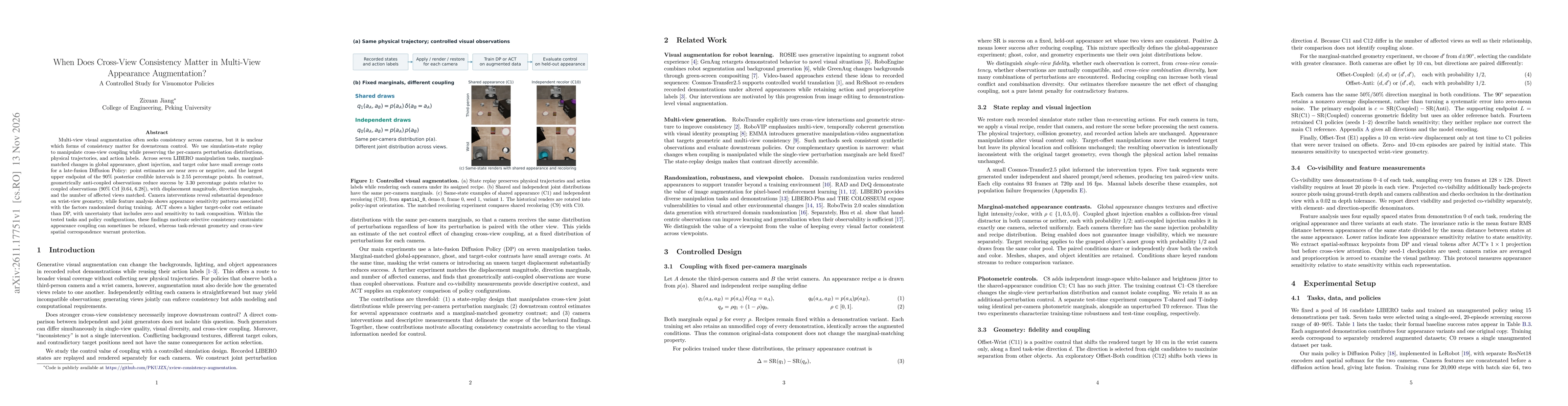
The authors use simulation-state replay to render each camera view separately while preserving per-camera perturbation distributions, physical trajectories, and action labels. They manipulate cross-view coupling (shared vs independent joint distributions) with marginal-matched changes in global appearance, ghost injection, target color, and geometric displacement, and evaluate a late-fusion Diffusion Policy (DP) and an ACT policy across seven LIBERO manipulation tasks.
SignificanceWhy the work matters
The study demonstrates that not all forms of cross‑view consistency are equally important for visuomotor control, suggesting that appearance coupling can often be relaxed while preserving task‑relevant geometry and spatial correspondence, thereby informing more efficient multi‑view augmentation strategies.
Technical contributionsWhat the work introduces
A state‑replay design that manipulates cross‑view joint distributions while preserving per‑camera marginals, providing downstream control estimates for various appearance and geometry contrasts, and delivering camera‑intervention measurements that delineate the behavioral impact of cross‑view consistency.
NoveltyHow it differs from prior work
First controlled, marginal‑matched study that isolates the effect of cross‑view consistency on visuomotor policy performance, revealing which consistency constraints are essential for successful control.
Future workQuestions that remain
- Conduct the missing high‑co‑visibility ghost and third‑person offset experiments.
- Complete the seed‑7 geometry unit recordings and divergence reruns.
- Investigate identity remapping, robot distortion, and temporal discontinuities that were not covered.
- Extend the controlled augmentation framework to other policies, tasks, and real‑world robot settings.
Discussion 0