When Every Rollout Fails: Splicing Learner-Conditioned Options into Long-Horizon Agent RL
Abstract
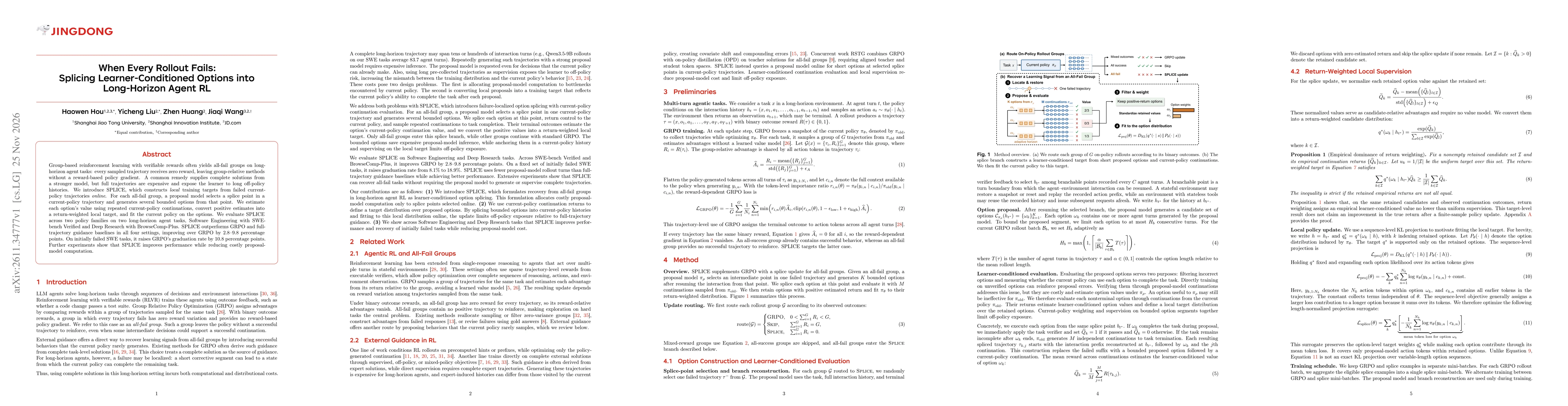
Group-based reinforcement learning with verifiable rewards often yields all-fail groups on long-horizon agent tasks: every sampled trajectory receives zero reward, leaving group-relative methods without a reward-based policy gradient. A common remedy supplies complete solutions from a stronger model, but full trajectories are expensive and expose the learner to long off-policy histories. We introduce SPLICE, which constructs local training targets from failed current-policy trajectories online. For each all-fail group, a proposal model selects a splice point in a current-policy trajectory and generates several bounded options from that point. We estimate each option's value using repeated current-policy continuations, convert positive estimates into a return-weighted local target, and fit the current policy on the options. We evaluate SPLICE across two policy families on two long-horizon agent tasks, Software Engineering with SWE-bench Verified and Deep Research with BrowseComp-Plus. SPLICE outperforms GRPO and full-trajectory guidance baselines in all four settings, improving over GRPO by 2.8--9.8 percentage points. On initially failed SWE tasks, it raises GRPO's graduation rate by 10.8 percentage points. Further experiments show that SPLICE improves performance while reducing costly proposal-model computation.
Analysis
AI-generated · verify against the original paper
Generated Jan 1, 0001ResultsWhat the authors found
- SPLICE outperforms GRPO and full-trajectory guidance baselines in all four settings, improving over GRPO by 2.8–9.8 percentage points.
- On initially failed SWE tasks, SPLICE raises GRPO's graduation rate by 10.8 percentage points (from 8.1% to 18.9%).
- SPLICE achieves better performance while using fewer proposal-model rollout turns than full-trajectory guidance baselines.
- Splice-point selection using the proposal model improves resolve by 1.3 points and graduation by 1.1 points over random selection.
LimitationsWhere the findings need caution
- The proposal-model computation, though reduced, remains a necessary cost.
- Splice-point selection based on local policy uncertainty provides only modest gains over random selection.
MethodologyHow the work was done
SPLICE selects a splice point in a failed current-policy trajectory using a proposal model, generates several bounded options from that point, estimates each option's value via repeated current-policy continuations, converts positive estimates into a return-weighted local target, and fits the current policy on these options, applying this only to all-fail groups while other groups use standard GRPO.
SignificanceWhy the work matters
The approach enables recovery from all-fail groups in long-horizon RL tasks without expensive full-trajectory guidance, reducing off-policy exposure and computational cost while substantially improving task success rates.
Technical contributionsWhat the work introduces
Introduces the SPLICE framework that constructs local training targets from failed trajectories by splicing learner-conditioned bounded options and evaluating them with current-policy continuations.
NoveltyHow it differs from prior work
First method to generate and evaluate bounded options from failed trajectories online, avoiding full trajectory generation and limiting off-policy exposure in long-horizon RL.
Discussion 0