When Fine-Grained Credit Assignment Helps and Hurts: Multimodal Agentic Reinforcement Learning through Video Editing
Abstract
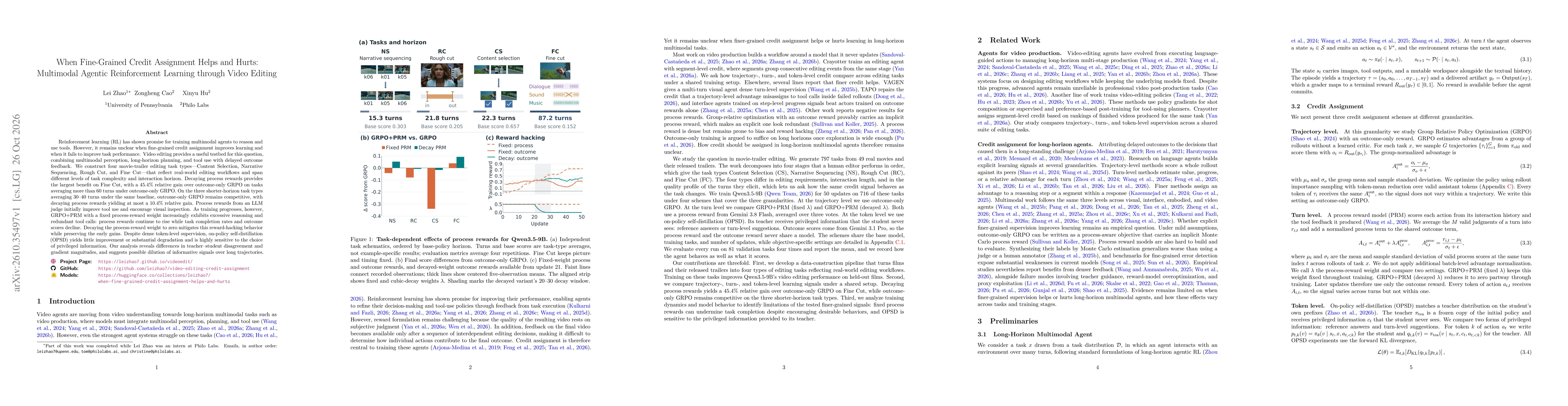
Reinforcement learning (RL) has shown promise for training multimodal agents to reason and use tools. However, it remains unclear when fine-grained credit assignment improves learning and when it fails to improve task performance. Video editing provides a useful testbed for this question, combining multimodal perception, long-horizon planning, and tool use with delayed outcome feedback. We construct four movie-trailer editing task types---Content Selection, Narrative Sequencing, Rough Cut, and Fine Cut---that reflect real-world editing workflows and span different levels of task complexity and interaction horizon. Decaying process rewards provides the largest benefit on Fine Cut, with a 45.4% relative gain over outcome-only GRPO on tasks averaging more than 60 turns under outcome-only GRPO. On the three shorter-horizon task types averaging 30--40 turns under the same baseline, outcome-only GRPO remains competitive, with decaying process rewards yielding at most a 10.4% relative gain. Process rewards from an LLM judge initially improve tool use and encourage visual inspection. As training progresses, however, GRPO+PRM with a fixed process-reward weight increasingly exhibits excessive reasoning and redundant tool calls: process rewards continue to rise while task completion rates and outcome scores decline. Decaying the process-reward weight to zero mitigates this reward-hacking behavior while preserving the early gains. Despite dense token-level supervision, on-policy self-distillation (OPSD) yields little improvement or substantial degradation and is highly sensitive to the choice of privileged information. Our analysis reveals differences in teacher--student disagreement and gradient magnitudes, and suggests possible dilution of informative signals over long trajectories.
AI Key Findings
Get AI-generated insights about this paper's methodology, results, significance, and more — available when analysis has been generated.
Discussion 0