When Skills Fail to Compose: Compatibility and Retention in Language Models
Abstract
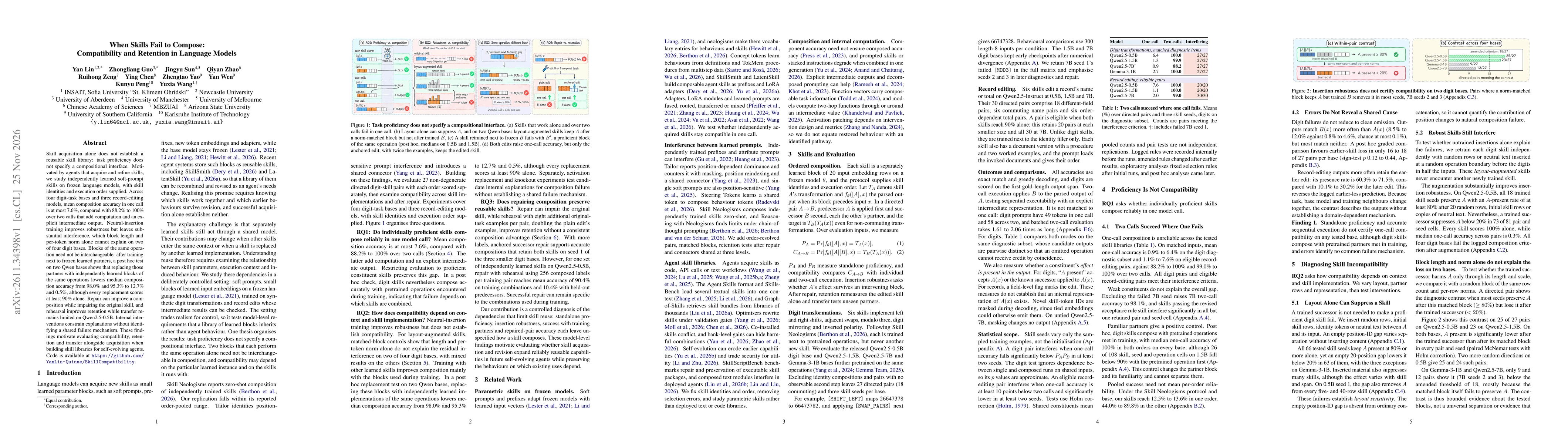
Skill acquisition alone does not establish a reusable skill library: task proficiency does not specify a compositional interface. Motivated by agents that acquire and refine skills, we study independently learned soft-prompt skills on frozen language models, with skill identities and execution order supplied. Across four digit-task bases and three record-editing models, mean composition accuracy in one call is at most 7.6%, compared with 88.2% to 100% over two calls that add computation and an explicit intermediate output. Neutral-insertion training improves robustness but leaves substantial interference, which block length and per-token norm alone cannot explain on two of four digit bases. Blocks of the same operation need not be interchangeable: after training next to frozen learned partners, a post hoc test on two Qwen bases shows that replacing those partners with independently learned blocks of the same operations lowers median composition accuracy from 98.0% and 95.3% to 12.7% and 0.5%, although every replacement scores at least 90% alone. Repair can improve a composition while impairing the original skill, and rehearsal improves retention while transfer remains limited on Qwen2.5-0.5B. Internal interventions constrain explanations without identifying a shared failure mechanism. These findings motivate evaluating compatibility, retention and transfer alongside acquisition when building skill libraries for self-evolving agents. Code is available at https://github.com/YanLin-Quinne/SkillCompatibility.
AI Key Findings
Get AI-generated insights about this paper's methodology, results, significance, and more — available when analysis has been generated.
Discussion 0