Which cosmological models -- with dark energy or modified FRW dynamics?
This paper compares cosmological models explaining the accelerating expansion of the universe, either through dark energy or modified Friedmann-Robertson-Walker (FRW) dynamics. Using Akaike and Bayesian information criteria, it finds that standard FRW dynamics without additional contributions are sufficient, favoring the flat phantom model according to AIC and both flat phantom and ΛCDM models according to BIC.
Abstract
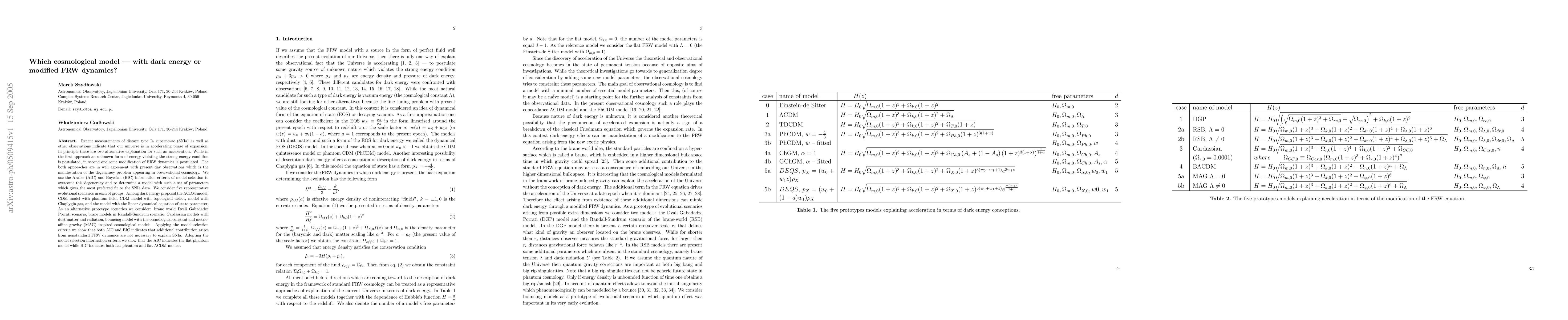
Recent measurements of distant type Ia supernovae (SNIa) as well as other observations indicate that our universe is in accelerating phase of expansion. In principle there are two alternative explanation for such an acceleration. While in the first approach an unknown form of energy violating the strong energy condition is postulated, in second one some modification of FRW dynamics is postulated. The both approaches are in well agreement with present day observations which is the manifestation of the degeneracy problem appearing in observational cosmology. We use the Akaike (AIC) and Bayesian (BIC) information criteria of model selection to overcome this degeneracy and to determine a model with such a set of parameters which gives the most preferred fit to the SNIa data. We consider five representative evolutional scenarios in each of groups. Among dark energy proposal the $\Lambda$CDM model, CDM model with phantom field, CDM model with topological defect, model with Chaplygin gas, and the model with the linear dynamical equation of state parameter. As an alternative prototype scenarios we consider: brane world Dvali Gabadadze Porrati scenario, brane models in Randall-Sundrum scenario, Cardassian models with dust matter and radiation, bouncing model with the cosmological constant and metric-affine gravity (MAG) inspired cosmological models. Applying the model selection criteria we show that both AIC and BIC indicates that additional contribution arises from nonstandard FRW dynamics are not necessary to explain SNIa. Adopting the model selection information criteria we show that the AIC indicates the flat phantom model while BIC indicates both flat phantom and flat $\Lambda$CDM models.
AI Key Findings
Get AI-generated insights about this paper's methodology, results, significance, and more — available when analysis has been generated.
Discussion 0