Why Does Sensor Depth Fail Learned Manipulation Policies? Finding the Failure Mode with ACT
Abstract
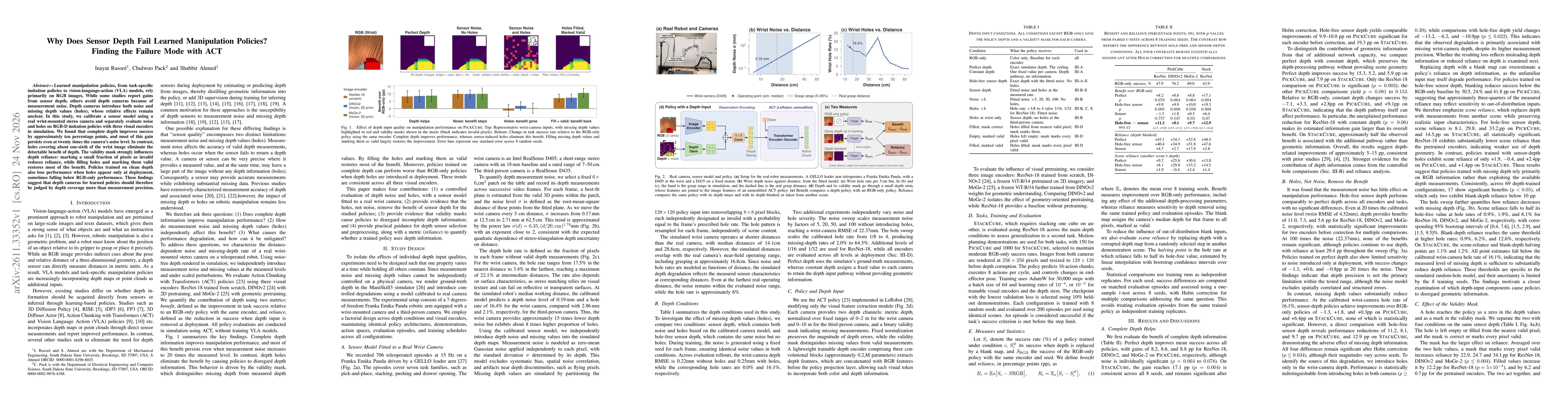
Learned manipulation policies, from task-specific imitation policies to vision-language-action (VLA) models, rely primarily on RGB images. While some studies report gains from sensor depth, others avoid depth cameras because of measurement noise. Depth cameras introduce both noise and missing depth values (holes), whose relative effects remain unclear. In this study, we calibrate a sensor model using a real wrist-mounted stereo camera and separately evaluate noise and holes on RGB-D imitation policies with three visual encoders in simulation. We found that complete depth improves success by approximately ten percentage points, and most of this gain persists even at twenty times the camera's noise level. In contrast, holes covering about one-sixth of the wrist image eliminate the detectable benefit of depth. The validity mask strongly influences depth reliance: marking a small fraction of pixels as invalid reduces reliance, while filling holes and marking them valid restores most of the benefit. Policies trained on clean depth also lose performance when holes appear only at deployment, sometimes falling below RGB-only performance. These findings suggest that depth cameras for learned policies should therefore be judged by depth coverage more than measurement precision.
Analysis
AI-generated · verify against the original paper
Generated Jan 1, 0001ResultsWhat the authors found
- Complete depth improves manipulation success by about ten percentage points compared to RGB‑only policies.
- The performance gain persists even when measurement noise is increased up to twenty times the calibrated level, with a bounded cost of ~3.6 pp.
- Depth holes covering roughly one‑sixth of the wrist image eliminate the benefit of depth, causing policies to ignore depth input.
- Filling holes and marking them as valid restores most of the performance gain, demonstrating the importance of the validity mask.
- Policies trained on clean depth lose success when holes appear only at deployment, sometimes falling below RGB‑only performance.
LimitationsWhere the findings need caution
- All experiments were conducted in simulation with a motion‑planner generated dataset, not on a physical robot.
- The depth corruption model simplifies real sensor behavior, using independent Gaussian noise and randomly placed square holes rather than correlated or surface‑dependent errors.
- Only a single policy class (ACT), one camera model, and two grasping tasks (plus one pushing task) were evaluated.
- Hole placement was random; although a supplemental experiment used real‑camera hole patterns, the effect of structured hole regions remains uncertain.
MethodologyHow the work was done
The authors calibrated a sensor model using a real wrist-mounted stereo camera, then rendered ground‑truth depth in simulation and independently injected controlled levels of Gaussian noise and missing‑depth holes. They trained Action Chunking with Transformers (ACT) manipulation policies with three visual encoders (ResNet‑18, DINOv2, MoGe‑2) on RGB‑D data and evaluated task success and depth reliance across a factorial design of depth conditions, keeping all other training and evaluation settings constant.
SignificanceWhy the work matters
The study shows that for learned manipulation policies, depth coverage (absence of holes) is far more critical than sensor precision, guiding sensor selection and preprocessing strategies for real‑world robotic systems.
Technical contributionsWhat the work introduces
A calibrated sensor model and a controlled simulation framework that independently varies depth noise and hole rates, combined with a new reliance metric to quantify how much a learned policy depends on depth input.
NoveltyHow it differs from prior work
The work isolates and demonstrates that missing‑depth holes, rather than measurement noise, are the primary cause of depth sensor failure in learned manipulation policies, a distinction not previously quantified.
Future workQuestions that remain
- Validate the findings on physical robots with real depth sensors and realistic hole patterns.
- Extend the analysis to a broader set of manipulation tasks and additional policy architectures, including full VLA models.
- Investigate more sophisticated depth corruption models that capture spatial and temporal correlations and sensor minimum range effects.
- Study the internal representations of policies to better understand how validity masks modulate depth reliance.
Discussion 0