Wind-Aware Trajectory Planning for Deformable Aerial Formations
Abstract
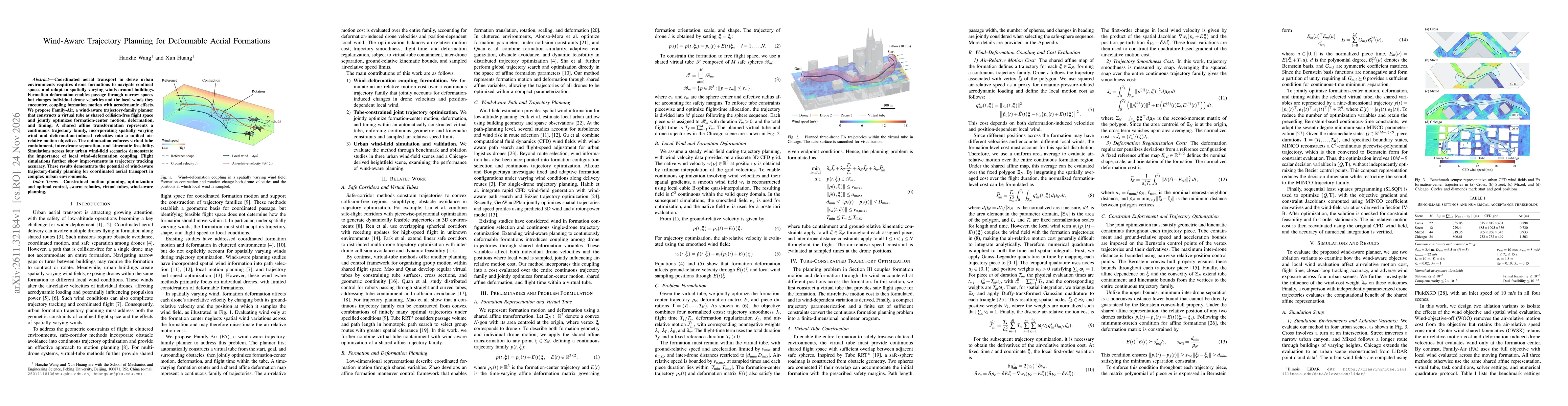
Coordinated aerial transport in dense urban environments requires drone formations to navigate confined spaces and adapt to spatially varying winds around buildings. Formation deformation enables passage through narrow spaces but changes individual drone velocities and the local winds they encounter, coupling formation motion with aerodynamic effects. We propose Family-Air, a wind-aware trajectory-family planner that constructs a virtual tube as shared collision-free flight space and jointly optimizes formation-center motion, deformation, and timing. A shared affine transformation represents a continuous trajectory family, incorporating spatially varying wind and deformation-induced velocities into a unified air-relative motion objective. The optimization enforces virtual-tube containment, inter-drone separation, and kinematic feasibility. Simulations across four urban wind-field scenarios demonstrate the importance of local wind-deformation coupling. Flight simulations further show improvements in trajectory tracking accuracy. These results demonstrate the potential of wind-aware trajectory-family planning for coordinated aerial transport in complex urban environments.
Analysis
AI-generated · verify against the original paper
Generated Jan 1, 0001ResultsWhat the authors found
- Simulations across four urban wind‑field scenarios show a significant reduction in air‑relative motion cost compared with wind‑oblivious baselines.
- The planner reduces adverse wind‑exposure metrics (Radv) and improves closed‑loop trajectory tracking accuracy despite tracking error not being directly optimized.
- Computational experiments demonstrate that the shared affine representation yields median speedups of 3.35× in optimizer time with negligible loss in objective quality.
LimitationsWhere the findings need caution
- Tracking error is not included in the planning objective, so improvements are observed only indirectly.
- Energy consumption is not modeled, limiting assessment of propulsion‑power trade‑offs.
MethodologyHow the work was done
Family-Air constructs a virtual tube as a shared collision‑free flight space and jointly optimizes formation‑center motion, time‑varying affine deformation, and segment durations using a compact MINCO parameterization that incorporates spatially varying wind and deformation‑induced velocities into a unified air‑relative motion cost, while enforcing tube containment, inter‑drone separation, and kinematic feasibility.
SignificanceWhy the work matters
The work enables coordinated aerial transport in dense urban environments by explicitly coupling formation deformation with spatially varying winds, improving safety, efficiency, and tracking performance for multi‑drone missions.
Technical contributionsWhat the work introduces
Introduces a wind‑deformation coupling formulation that evaluates air‑relative motion cost over a continuous trajectory family, and a tube‑constrained joint optimization that simultaneously solves for formation‑center path, shared affine deformation, and timing within a virtual tube.
NoveltyHow it differs from prior work
First approach to jointly account for spatially varying winds and formation deformation over an entire trajectory family, enabling wind‑aware planning for deformable aerial formations within virtual tubes.
Future workQuestions that remain
- Incorporate propulsion‑power models to evaluate actual energy consumption of wind‑aware, deformable formations.
Discussion 0