Wireless Node Ranking via Fourier-Driven Maximum-Likelihood Estimation (extended version)
Abstract
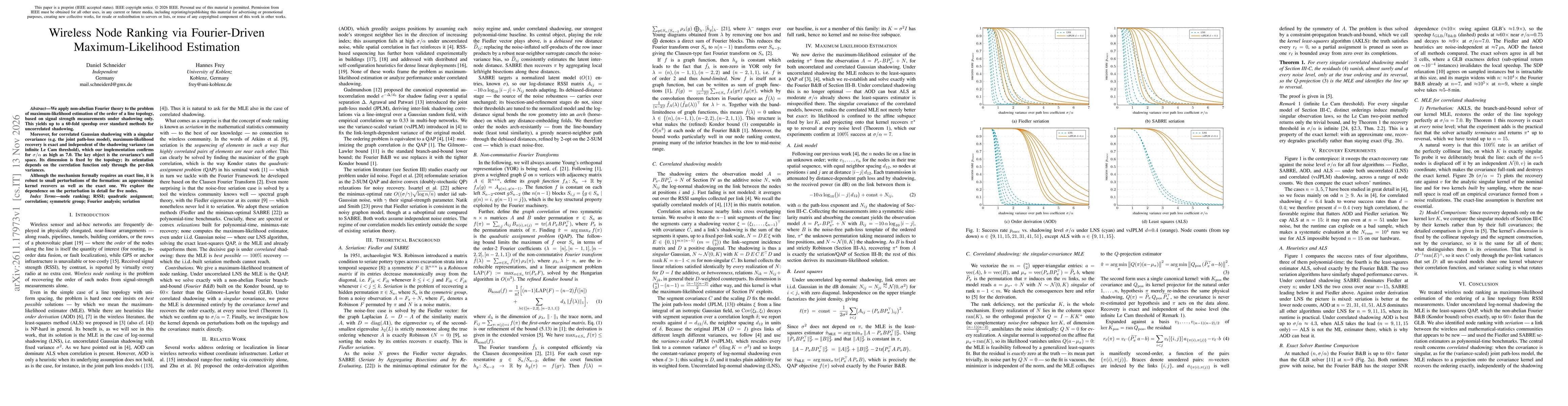
We apply non-abelian Fourier theory to the problem of maximum-likelihood estimation of the order of a line topology, based on signal strength measurements under shadowing only. This yields up to a 60-fold speedup over standard methods for uncorrelated shadowing. Moreover, for correlated Gaussian shadowing with a singular covariance (e.g. the joint path-loss model), maximum-likelihood recovery is exact and independent of the shadowing variance (an infinite Le Cam threshold), which our implementation confirms for $σ/α$ as high as 7.0. The key object is the covariance's null space. Its dimension is fixed by the topology; its orientation depends on the correlation function only through the per-link variances. Although the mechanism formally requires an exact line, it is robust to small perturbations of the formation: an approximate kernel recovers as well as the exact one. We explore the dependence on the perturbation in detail for five nodes.
Analysis
AI-generated · verify against the original paper
Generated Jan 1, 0001ResultsWhat the authors found
- The Fourier B&B solver achieves up to a 60‑fold speedup over the standard Gilmore–Lawler bound for uncorrelated log‑normal shadowing.
- For correlated Gaussian shadowing with a singular covariance (e.g., the variance‑scaled joint path‑loss model) the MLE recovers the exact node order independent of the shadowing variance, confirmed up to σ/α = 7.0.
- The recovery remains robust to small perturbations of the line formation; an approximate kernel still yields near‑perfect recovery for five‑node scenarios.
- Experimental comparisons show that the exact solver outperforms polynomial‑time seriation baselines (Fiedler, SABRE, AOD) in both success rate and runtime under correlated shadowing.
LimitationsWhere the findings need caution
- Exact recovery guarantees rely on a perfectly collinear line topology; deviations require an approximate kernel and lead to graceful performance degradation.
- The ALS solver, while fast for small n, is not the MLE and its runtime can explode for larger networks (n > 15).
- The proposed Fourier B&B, though faster than GLB, still exhibits increased runtime at high noise levels (σ/α ≈ 7).
MethodologyHow the work was done
The authors formulate wireless node ranking as a maximum‑likelihood estimation problem and solve it using non‑abelian Fourier analysis combined with a branch‑and‑bound algorithm (Fourier B&B) that exploits the Kondor bound. For correlated shadowing with a singular covariance they reduce the MLE to a projection onto the covariance kernel’s null space, and they evaluate the approach experimentally on synthetic line topologies with both uncorrelated and correlated shadowing.
SignificanceWhy the work matters
The work bridges wireless node ranking with the statistical seriation problem, providing the first exact MLE solution for correlated shadowing and demonstrating that non‑abelian Fourier methods can dramatically accelerate quadratic‑assignment‑type estimators in practical wireless sensor networks.
Technical contributionsWhat the work introduces
Introduces a Fourier‑driven branch‑and‑bound algorithm that solves the exact least‑squares QAP formulation of the MLE for node ranking, and proves that under singular correlated shadowing the MLE depends solely on the covariance kernel, enabling variance‑independent exact recovery.
NoveltyHow it differs from prior work
First to apply non‑abelian Fourier analysis to wireless node ranking, revealing a deep connection to seriation and providing an infinite Le Cam threshold for correlated shadowing, together with a dramatically faster exact solver for the underlying quadratic assignment problem.
Future workQuestions that remain
- Develop a polynomial‑time approximation algorithm for the kernel‑based MLE, possibly by pairing the projection with seriation heuristics.
- Classify and characterize different recovery kernels arising from various correlation models.
- Conduct field experiments on real linear deployments to validate the approach beyond simulations.
- Extend the methodology to non‑linear or more general structured arrays where singular covariances may also arise.
Discussion 0