WoCoCo: Learning Whole-Body Humanoid Control with Sequential Contacts
WoCoCo presents a framework for learning whole-body humanoid control through reinforcement learning, focusing on tasks involving sequential contacts. It decomposes complex tasks into manageable contact stages, enabling effective policy learning with minimal task-specific tuning and demonstrating success in various real-world challenges.
Abstract
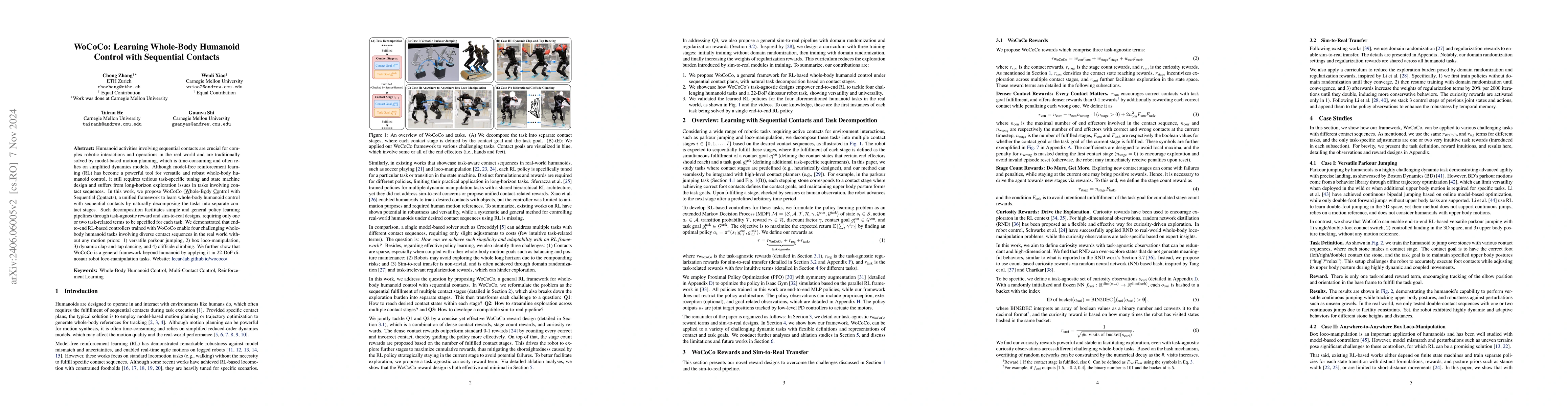
Humanoid activities involving sequential contacts are crucial for complex robotic interactions and operations in the real world and are traditionally solved by model-based motion planning, which is time-consuming and often relies on simplified dynamics models. Although model-free reinforcement learning (RL) has become a powerful tool for versatile and robust whole-body humanoid control, it still requires tedious task-specific tuning and state machine design and suffers from long-horizon exploration issues in tasks involving contact sequences. In this work, we propose WoCoCo (Whole-Body Control with Sequential Contacts), a unified framework to learn whole-body humanoid control with sequential contacts by naturally decomposing the tasks into separate contact stages. Such decomposition facilitates simple and general policy learning pipelines through task-agnostic reward and sim-to-real designs, requiring only one or two task-related terms to be specified for each task. We demonstrated that end-to-end RL-based controllers trained with WoCoCo enable four challenging whole-body humanoid tasks involving diverse contact sequences in the real world without any motion priors: 1) versatile parkour jumping, 2) box loco-manipulation, 3) dynamic clap-and-tap dancing, and 4) cliffside climbing. We further show that WoCoCo is a general framework beyond humanoid by applying it in 22-DoF dinosaur robot loco-manipulation tasks.
AI Key Findings
Get AI-generated insights about this paper's methodology, results, significance, and more — available when analysis has been generated.
Discussion 0