3D Concept Learning and Reasoning from Multi-View Images
This paper introduces a new 3D multi-view visual question answering (3DMV-VQA) benchmark and proposes a 3D concept learning and reasoning (3D-CLR) framework to improve 3D reasoning from multi-view images. The framework outperforms existing models but indicates that the broader challenge of 3D reasoning remains largely unsolved.
Abstract
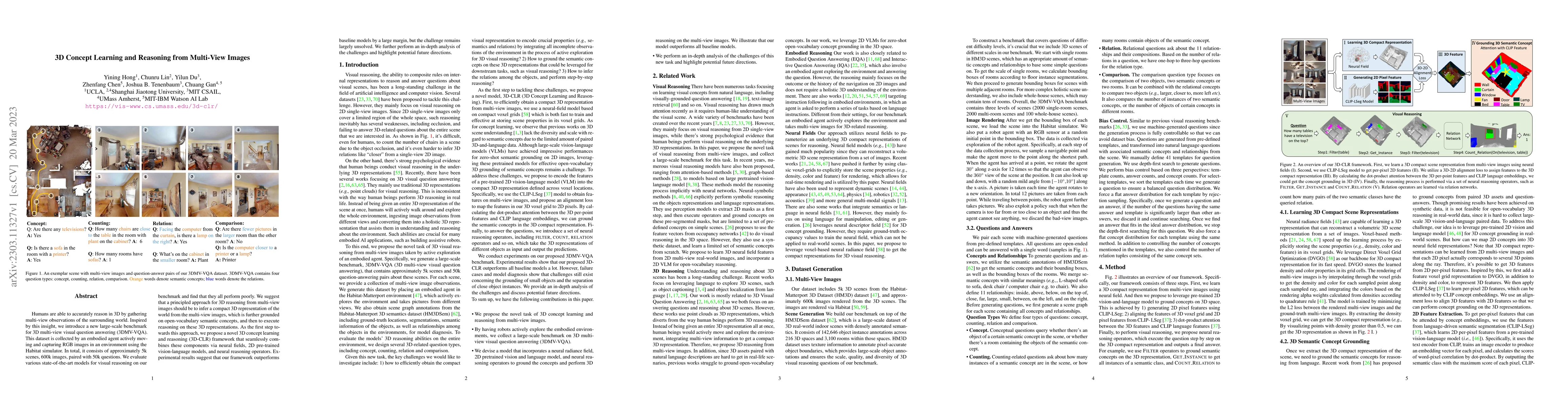
Humans are able to accurately reason in 3D by gathering multi-view observations of the surrounding world. Inspired by this insight, we introduce a new large-scale benchmark for 3D multi-view visual question answering (3DMV-VQA). This dataset is collected by an embodied agent actively moving and capturing RGB images in an environment using the Habitat simulator. In total, it consists of approximately 5k scenes, 600k images, paired with 50k questions. We evaluate various state-of-the-art models for visual reasoning on our benchmark and find that they all perform poorly. We suggest that a principled approach for 3D reasoning from multi-view images should be to infer a compact 3D representation of the world from the multi-view images, which is further grounded on open-vocabulary semantic concepts, and then to execute reasoning on these 3D representations. As the first step towards this approach, we propose a novel 3D concept learning and reasoning (3D-CLR) framework that seamlessly combines these components via neural fields, 2D pre-trained vision-language models, and neural reasoning operators. Experimental results suggest that our framework outperforms baseline models by a large margin, but the challenge remains largely unsolved. We further perform an in-depth analysis of the challenges and highlight potential future directions.
AI Key Findings
Get AI-generated insights about this paper's methodology, results, significance, and more — available when analysis has been generated.
Discussion 0