3D-EMCAD: Efficient Multi-scale Convolutional Attention Decoding for Volumetric Brain Tumor Segmentation
Abstract
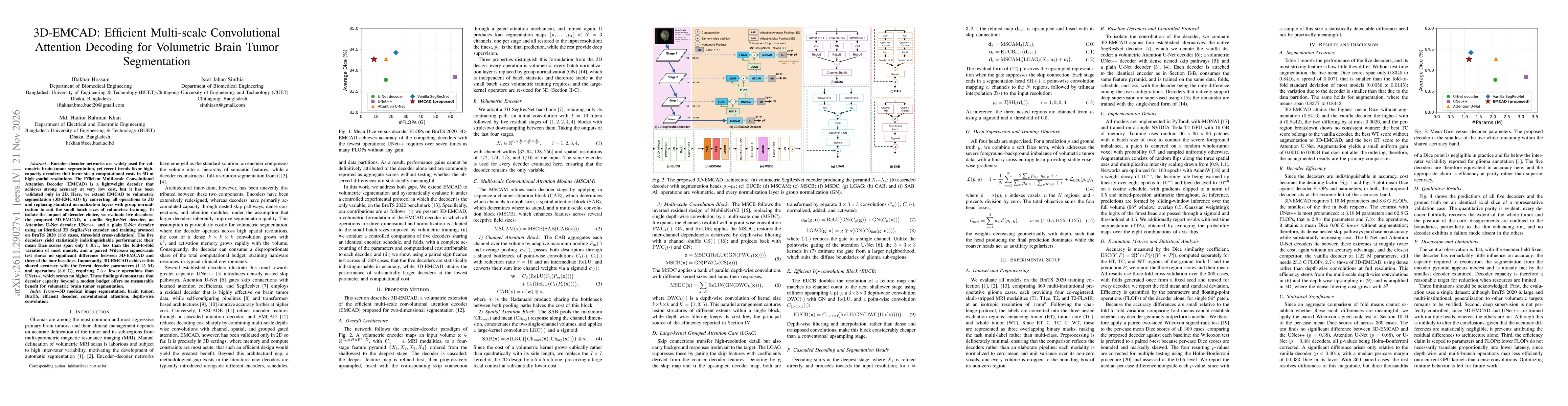
Encoder-decoder networks are widely used for volumetric brain tumor segmentation, yet recent trends favor high-capacity decoders that incur steep computational costs in 3D at high spatial resolutions. The Efficient Multi-scale Convolutional Attention Decoder (EMCAD) is a lightweight decoder that achieves strong accuracy at very low cost, but it has been validated only in 2D. Here, we extend EMCAD to volumetric segmentation (3D-EMCAD) by converting all operations to 3D and replacing standard normalization layers with group normalization to suit the small batch sizes of volumetric training. To isolate the impact of decoder choice, we evaluate five decoders: the proposed 3D-EMCAD, a vanilla SegResNet decoder, an Attention U-Net decoder, UNet++, and a plain U-Net decoder using an identical 3D SegResNet encoder and training protocol on BraTS 2020 (369 cases, three-fold cross-validation). The five decoders yield statistically indistinguishable performance: their mean Dice scores span only 0.0071, less than the fold-to-fold variation of most models, and a paired Wilcoxon signed-rank test shows no significant difference between 3D-EMCAD and three of the four baselines. Importantly, 3D-EMCAD achieves this shared accuracy with the fewest decoder parameters (1.15 M) and operations (8.6 G), requiring $7.3\times$ fewer operations than UNet++, which scores no higher. These findings demonstrate that decoder capacity beyond a modest budget offers no measurable benefit for volumetric brain tumor segmentation.
AI Key Findings
Get AI-generated insights about this paper's methodology, results, significance, and more — available when analysis has been generated.
Discussion 0