A Continuous Payload-Bearing Discrete Multitone Modulation Framework for Fiber-Optic Integrated Sensing and Communication
Abstract
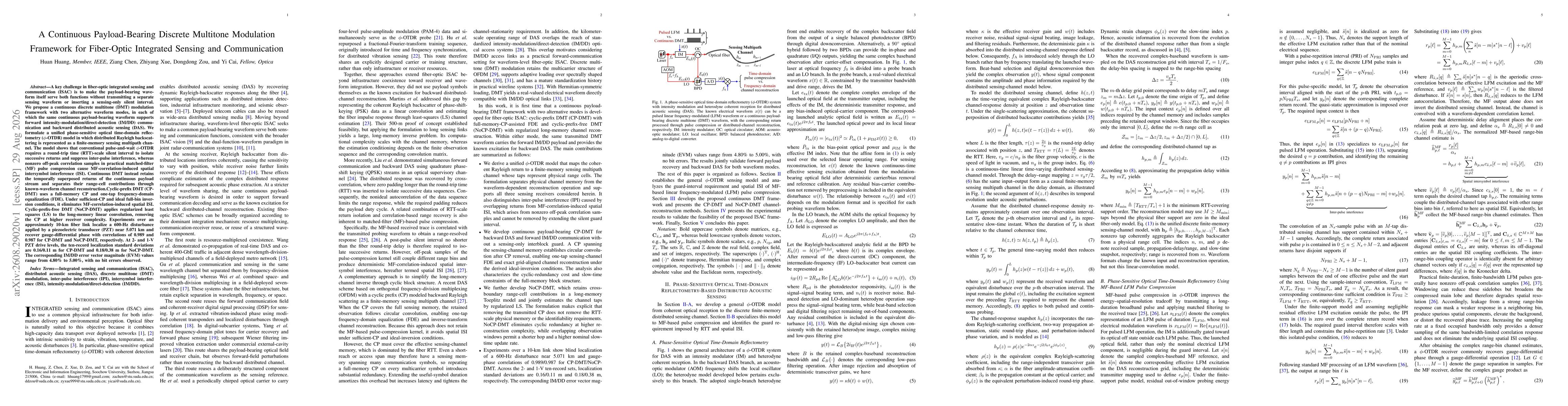
A key challenge in fiber-optic integrated sensing and communication (ISAC) is to make the payload-bearing waveform itself serve both functions without a separate sensing waveform or sensing-only silent interval. We propose a continuous discrete multitone (DMT) framework with two waveform modes, in which the same payload-bearing waveform supports forward intensity-modulation/direct-detection (IM/DD) communication and backward distributed acoustic sensing (DAS). A unified phase-sensitive optical time-domain reflectometry (φ-OTDR) model represents distributed Rayleigh backscattering as a finite-memory sensing multipath channel. It shows that conventional pulse-and-wait φ-OTDR requires a round-trip-time-scale silent interval to isolate successive returns, while nonzero off-peak samples in practical matched-filter (MF) pulse compression cause spatial intersymbol interference (ISI). Continuous DMT instead retains superposed returns and separates range-cell contributions through known-waveform channel reconstruction. Cyclic-prefix DMT (CP-DMT) uses a full-memory CP and one-tap frequency-domain equalization (FDE); under sufficient-CP and ideal full-bin inversion conditions, it eliminates MF-correlation-induced spatial ISI. Cyclic-prefix-free DMT (NoCP-DMT) applies regularized least squares (LS) to the long-memory linear convolution, avoiding the CP at higher receiver complexity. Experiments over a 10-km fiber link localize a 600-Hz disturbance applied by a piezoelectric transducer (PZT) near 5.071 km and recover gauge-differential phase with correlations of 0.989 and 0.987 for CP-DMT and NoCP-DMT, respectively. At 2- and 1-V PZT drive levels, the ten-record localization standard deviations are 0.16/0.11 m and 0.18/0.38 m, respectively. The corresponding IM/DD error vector magnitude values range from 4.80% to 5.00%, with no bit errors observed.
Analysis
AI-generated · verify against the original paper
Generated Jan 1, 0001ResultsWhat the authors found
- Gauge‑differential phase correlations of 0.9982 (CP‑DMT) and 0.9983 (NoCP‑DMT) were achieved for a 600‑Hz disturbance at 5.071 km.
- Localization standard deviations across 15 records were 0.43 m / 0.41 m (CP‑DMT) and 0.38 m / 0.38 m (NoCP‑DMT) for 2‑V and 1‑V PZT drive levels respectively.
- IM/DD error vector magnitude values ranged from 4.79 % to 5.01 % with no bit errors observed.
LimitationsWhere the findings need caution
- Finite reconstruction bandwidth and regularization can cause practical spreading in the estimated channel.
- The experimental dataset is limited to fifteen records per condition, insufficient to statistically establish voltage‑dependence of localization precision.
- NoCP‑DMT incurs higher receiver computational complexity due to regularized least‑squares processing.
MethodologyHow the work was done
The paper proposes a continuous discrete multitone (DMT) framework for fiber‑optic integrated sensing and communication (ISAC) that uses the same payload‑bearing waveform for forward IM/DD communication and backward φ‑OTDR distributed acoustic sensing. A unified phase‑sensitive OTDR model represents Rayleigh backscatter as a finite‑memory multipath channel. Two modes are developed: cyclic‑prefix DMT (CP‑DMT) with a full‑memory cyclic prefix and one‑tap frequency‑domain equalization, and cyclic‑prefix‑free DMT (NoCP‑DMT) that reconstructs the long‑memory linear convolution via regularized least‑squares. Experiments over an approximately 10‑km fiber link evaluate both modes by localizing a 600‑Hz piezoelectric disturbance and measuring communication error vector magnitude.
SignificanceWhy the work matters
The work demonstrates that a continuous payload‑bearing DMT waveform can simultaneously support high‑rate IM/DD communication and distributed acoustic sensing without a separate sensing waveform or silent guard interval, thereby simplifying ISAC system design and improving spectral efficiency.
Technical contributionsWhat the work introduces
A unified φ‑OTDR finite‑memory channel model separating physical memory from waveform‑dependent reconstruction, the design of CP‑DMT with full‑memory cyclic prefix enabling one‑tap frequency‑domain equalization, and the development of NoCP‑DMT employing regularized least‑squares for long‑memory channel estimation, all validated experimentally on a 10‑km link.
NoveltyHow it differs from prior work
First demonstration of a continuous payload‑bearing discrete multitone modulation scheme that simultaneously provides forward IM/DD communication and backward distributed acoustic sensing without requiring a separate sensing waveform or silent interval.
Future workQuestions that remain
- Collect a larger number of repeated acquisitions to enable rigorous statistical characterization of localization accuracy and voltage dependence.
- Investigate methods to reduce reconstruction bandwidth limitations and improve regularization strategies.
- Explore scalability of the framework to longer fiber links and higher data‑rate IM/DD communication scenarios.
Discussion 0