A Shift in Perspective on Causality in Domain Generalization
Abstract
The promise that causal modelling can lead to robust AI generalization has been challenged in recent work on domain generalization (DG) benchmarks. We revisit the claims of the causality and DG literature, reconciling apparent contradictions and advocating for a more nuanced theory of the role of causality in generalization. We also provide an interactive demo at https://chai-uk.github.io/ukairs25-causal-predictors/.
Analysis
AI-generated · verify against the original paper
Generated Sep 7, 2025ResultsWhat the authors found
- Empirical evidence from DG benchmarks shows that models using all available features often outperform causal feature-based models.
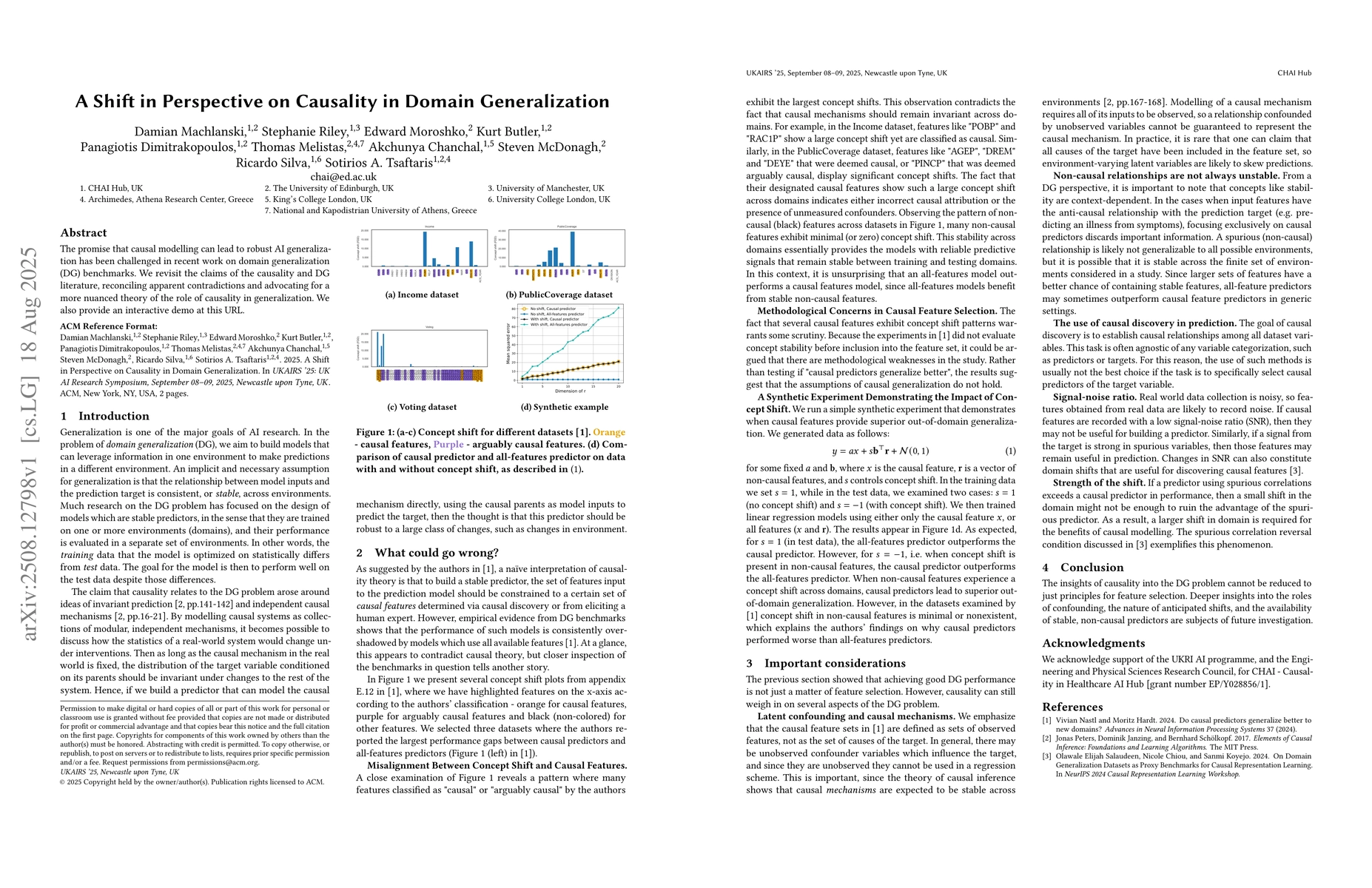
- Many features classified as 'causal' or 'arguably causal' exhibit large concept shifts, contradicting the expectation of invariant causal mechanisms across domains.
- A synthetic experiment demonstrates that causal predictors can outperform all-features predictors when non-causal features experience concept shift across domains.
- The study highlights that achieving good DG performance is not solely a matter of feature selection, and causality can still play a role in several aspects of the DG problem.
LimitationsWhere the findings need caution
- The study did not evaluate concept stability before including features in the feature set, which could be a methodological weakness.
- The datasets examined in the study showed minimal or no concept shift in non-causal features, explaining the authors' findings on causal predictor performance.
MethodologyHow the work was done
The paper revisits claims in causality and domain generalization (DG) literature, reconciling contradictions and advocating for a nuanced theory of causality's role in generalization. It also provides an interactive demo.
SignificanceWhy the work matters
This research is important as it challenges the naive interpretation of causal theory in DG, showing that empirical evidence from benchmarks does not support the assumption of causal generalization.
Technical contributionsWhat the work introduces
The paper presents a nuanced theory of causality's role in domain generalization, reconciling apparent contradictions in previous literature and demonstrating conditions under which causal predictors can outperform all-features predictors.
NoveltyHow it differs from prior work
The research distinguishes itself by challenging the common assumption that causal predictors always generalize better to new domains, emphasizing the importance of concept shifts and stability in non-causal features.
Future workQuestions that remain
- Investigate deeper insights into the role of confounding, nature of anticipated shifts, and availability of stable, non-causal predictors in DG.
- Explore the use of causal discovery in prediction tasks more carefully, considering the signal-noise ratio and strength of domain shifts.
Discussion 0