A Simple Necessary and Sufficient Condition for Yang--Baxter Integrability
Abstract
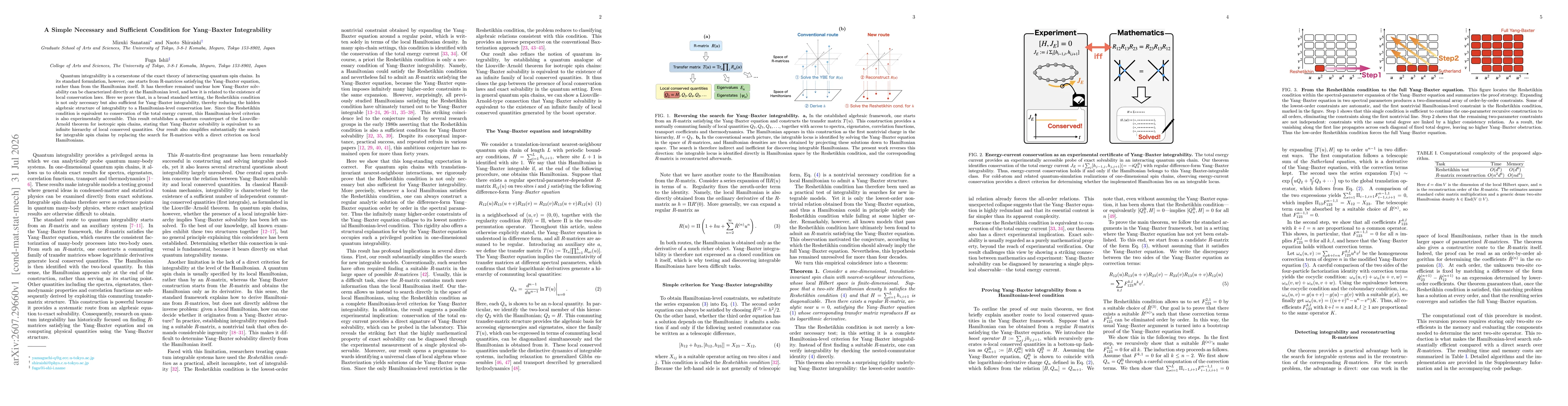
Quantum integrability is a cornerstone of the exact theory of interacting quantum spin chains. In its standard formulation, however, one starts from R-matrices satisfying the Yang--Baxter equation, rather than from the Hamiltonian itself. It has therefore remained unclear how Yang--Baxter solvability can be characterized directly at the Hamiltonian level, and how it is related to the existence of local conservation laws. Here we prove that, in a broad standard setting, the Reshetikhin condition is not only necessary but also sufficient for Yang--Baxter integrability, thereby reducing the hidden algebraic structure of integrability to a Hamiltonian-level conservation law. Since the Reshetikhin condition is equivalent to conservation of the total energy current, this Hamiltonian-level criterion is also experimentally accessible. This result establishes a quantum counterpart of the Liouville--Arnold theorem for isotropic spin chains, stating that Yang--Baxter solvability is equivalent to an infinite hierarchy of local conserved quantities. Our result also simplifies substantially the search for integrable spin chains by replacing the search for R-matrices with a direct criterion on local Hamiltonians.
Analysis
AI-generated · verify against the original paper
Generated Aug 4, 2026ResultsWhat the authors found
- The Reshetikhin condition is both necessary and sufficient for Yang–Baxter integrability in the standard setting of translation-invariant nearest-neighbor spin chains.
- Yang–Baxter solvability becomes equivalent to the existence of an infinite hierarchy of local conserved quantities generated by the boost operator, akin to a quantum Liouville–Arnold theorem for isotropic spin chains.
- Higher-order Yang–Baxter constraints collapse to the Hamiltonian-level condition, allowing integrable models to be identified directly from local Hamiltonians without constructing R-matrices.
LimitationsWhere the findings need caution
- The proof is presented for translation-invariant nearest-neighbor interactions; extensions to more general interactions or boundary conditions are not detailed.
- The argument relies on a regular, spectral-parameter-dependent R-matrix near (0,0); non-regular or degenerate cases are not addressed.
- Practical implementation for arbitrary models may still require nontrivial verification of the Reshetikhin condition in complex Hamiltonians.
MethodologyHow the work was done
The authors establish that for translation-invariant nearest-neighbor quantum spin chains, the Reshetikhin condition is not only necessary but sufficient for Yang–Baxter integrability. They prove this by showing that, under a regular R-matrix near a spectral parameter point, the infinite Yang–Baxter hierarchy collapses to the lowest nontrivial Hamiltonian-level condition. They derive this through a detailed operator analysis using the boost and commutator framework, boundary term scrutiny, and adjoint action identities to relate higher charges to the energy-current conservation.
SignificanceWhy the work matters
This result provides a direct Hamiltonian-level criterion for integrability, linking conservation of the total energy current to Yang–Baxter solvability, and offering an experimental signature and a practical route to discover integrable models by analyzing local Hamiltonians rather than R-matrices.
Technical contributionsWhat the work introduces
A rigorous demonstration that the Reshetikhin condition suffices for Yang–Baxter integrability in translation-invariant nearest-neighbor quantum spin chains, showing the infinite hierarchy of local charges reduces to the Hamiltonian-level conservation law via boost-generated charges and boundary-term analysis.
NoveltyHow it differs from prior work
Provides the first general proof that the Reshetikhin condition is a complete, Hamiltonian-level criterion for Yang–Baxter integrability, establishing a quantum Liouville–Arnold-type equivalence and enabling direct Hamiltonian-based discovery of integrable models.
Future workQuestions that remain
- Generalize the sufficiency result to broader classes of Hamiltonians, including long-range or nontranslation-invariant systems.
- Explore experimental protocols to measure total energy-current conservation as a diagnostic of Yang–Baxter integrability.
- Classify algebras of local relations compatible with the Reshetikhin condition to identify universal families with Baxterization yielding Yang–Baxter solutions.
Discussion 0