ActiveBridge: Scaling Active Prior for Robots through Egocentric Perception-Interaction Modeling
Abstract
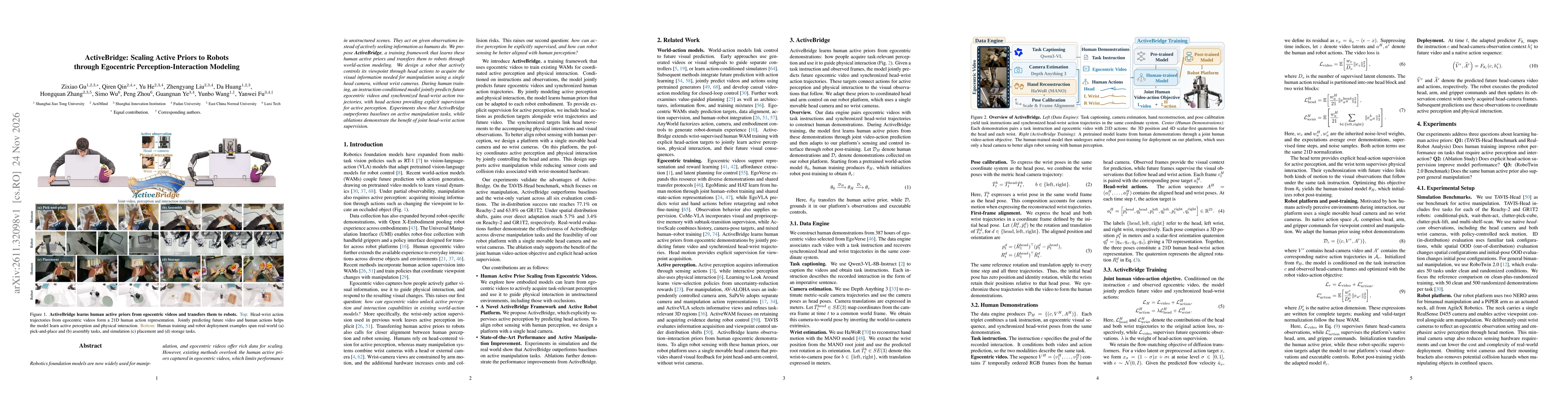
Robotics foundation models are now widely used for manipulation, and egocentric videos offer rich data for scaling. However, existing methods overlook the human active priors captured in egocentric videos, which limits performance in unstructured scenes. They act on given observations instead of actively seeking information as humans do. We propose ActiveBridge, a training framework that learns these human active priors and transfers them to robots through world-action modeling. We design a robot that actively controls its viewpoint through head actions to acquire the visual information needed for manipulation using a single head camera, without wrist cameras. During human training, an instruction-conditioned model jointly predicts future egocentric videos and synchronized head-wrist action trajectories, with head actions providing explicit supervision for active perception. Experiments show that ActiveBridge outperforms baselines on active manipulation tasks, while ablations demonstrate the benefit of joint head-wrist action supervision.
Analysis
AI-generated · verify against the original paper
Generated Jan 1, 0001ResultsWhat the authors found
- ActiveBridge outperforms baseline methods on active manipulation tasks in simulation and real‑world experiments.
- The in‑distribution success rate reaches 77.1% on the Reachy‑2 robot and 63.8% on the GR1T2 robot.
- Under spatial distribution shifts, ActiveBridge gains 5.7% on Reachy‑2 and 3.4% on GR1T2 compared to direct adaptation.
MethodologyHow the work was done
ActiveBridge trains an instruction-conditioned model that jointly predicts future egocentric videos and synchronized head‑wrist action trajectories, using head actions as explicit supervision for active perception, and deploys a robot with a single movable head camera to control its viewpoint during manipulation.
SignificanceWhy the work matters
The framework enables robots to actively acquire task‑relevant visual information with a single head camera, reducing sensor cost and collision risk while improving manipulation performance in unstructured environments.
Technical contributionsWhat the work introduces
Introduces explicit head‑action supervision within a world‑action model and demonstrates a robot platform that coordinates head and arm movements for active perception without wrist‑mounted cameras.
NoveltyHow it differs from prior work
First approach to learn and transfer human active priors from egocentric videos to robots, jointly modeling future video, head, and wrist actions to achieve active perception and manipulation.
Discussion 0