Adaptive Action Horizon Selection via Flow-Field Uncertainty
Abstract
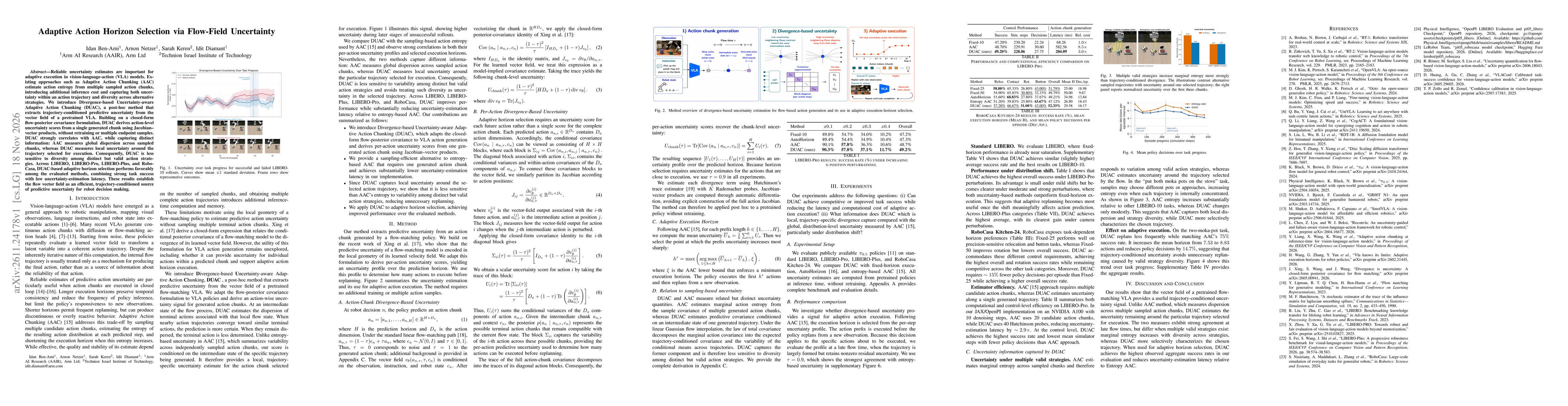
Reliable uncertainty estimates are important for adaptive execution in vision-language-action (VLA) models. Existing approaches such as Adaptive Action Chunking (AAC) estimate action entropy from multiple sampled action chunks, introducing additional inference cost and capturing both uncertainty within an action trajectory and diversity across alternative strategies. We introduce Divergence-based Uncertainty-aware Adaptive Action Chunking (DUAC), a post-hoc method that extracts trajectory-conditioned predictive uncertainty from the vector field of a pretrained VLA. Building on a closed-form flow-posterior covariance formulation, DUAC derives action-level uncertainty scores from a single generated chunk using Jacobian-vector products, without retraining or multiple endpoint samples. DUAC strongly correlates with AAC, while capturing distinct information: AAC measures global dispersion across sampled chunks, whereas DUAC measures local uncertainty around the trajectory selected for execution. Consequently, DUAC is less sensitive to diversity among distinct but valid action strategies. Across LIBERO, LIBERO-Pro, LIBERO-Plus, and RoboCasa, DUAC-based adaptive horizon selection performs favorably among the evaluated methods, combining strong task success with low uncertainty-estimation latency. These results establish the flow vector field as an efficient, trajectory-conditioned source of predictive uncertainty for robot decision making.
Analysis
AI-generated · verify against the original paper
Generated Jan 1, 0001ResultsWhat the authors found
- DUAC strongly correlates with the entropy‑based AAC scores (Pearson correlation up to 0.88 for chunk‑level and 0.80 for per‑action profiles).
- Across LIBERO, LIBERO‑Pro, LIBERO‑Plus, and RoboCasa, DUAC achieves comparable or higher task success while substantially reducing uncertainty‑estimation latency.
- DUAC improves success rates on RoboCasa door tasks (e.g., +26 pp on OpenDoubleDoor) and reduces the number of policy decisions per episode by 1.48–5.66.
- DUAC shows monotonic increase of uncertainty under increasing perturbations, tracking performance degradation.
LimitationsWhere the findings need caution
- DUAC relies on the quality of the pretrained flow‑matching VLA and its local geometry, which may limit its applicability when the model is poorly calibrated.
- The method captures only local uncertainty around the selected trajectory and may miss global diversity among distinct but valid strategies.
MethodologyHow the work was done
DUAC extracts trajectory‑conditioned predictive uncertainty from the vector field of a pretrained flow‑matching VLA by adapting a closed‑form flow‑posterior covariance formulation. It computes per‑action uncertainty scores from a single generated action chunk using Jacobian‑vector products, without additional training or multiple endpoint samples, and uses these scores for adaptive horizon selection.
SignificanceWhy the work matters
The work demonstrates that the flow vector field of a VLA can serve as an efficient, trajectory‑conditioned source of predictive uncertainty, enabling fast adaptive horizon selection without the computational overhead of sampling multiple action chunks.
Technical contributionsWhat the work introduces
Introduces Divergence‑based Uncertainty‑aware Adaptive Action Chunking (DUAC), a post‑hoc uncertainty estimator that adapts a closed‑form flow‑posterior covariance to VLA policies and derives per‑action uncertainty scores using Jacobian‑vector products from a single action chunk.
NoveltyHow it differs from prior work
First to leverage the learned vector‑field geometry of flow‑matching VLA models for fast, trajectory‑specific uncertainty estimation without sampling multiple action chunks.
Discussion 0