Adaptive Beamforming Using One-Bit Data Samples for Covariance Estimation
Abstract
The use of one-bit quantized complex-valued data samples enables efficient distributed computation of an array data covariance. This reduced complexity covariance estimate can be used for adaptive beamforming, but requires careful diagonal loading and results in lower performance compared to a full-precision approach. Two main approaches are presented: a covariance matrix built out of complex one-bit data samples, and a ``hybrid'' cross-covariance between the one-bit data and the full precision data. Signal-to-interference-plus-noise ratio (SINR) estimates for the associated population and finite-sample matrices are derived and compared to the full precision results using tools from linear algebra and statistics. Many strong, well-separated interferers with low overlap with the signal of interest are assumed throughout, none of them dominant.
Analysis
AI-generated · verify against the original paper
Generated Jan 1, 0001ResultsWhat the authors found
- SINR formulas are derived for the one‑bit and hybrid covariance estimators and shown to be lower than those of full‑precision covariance.
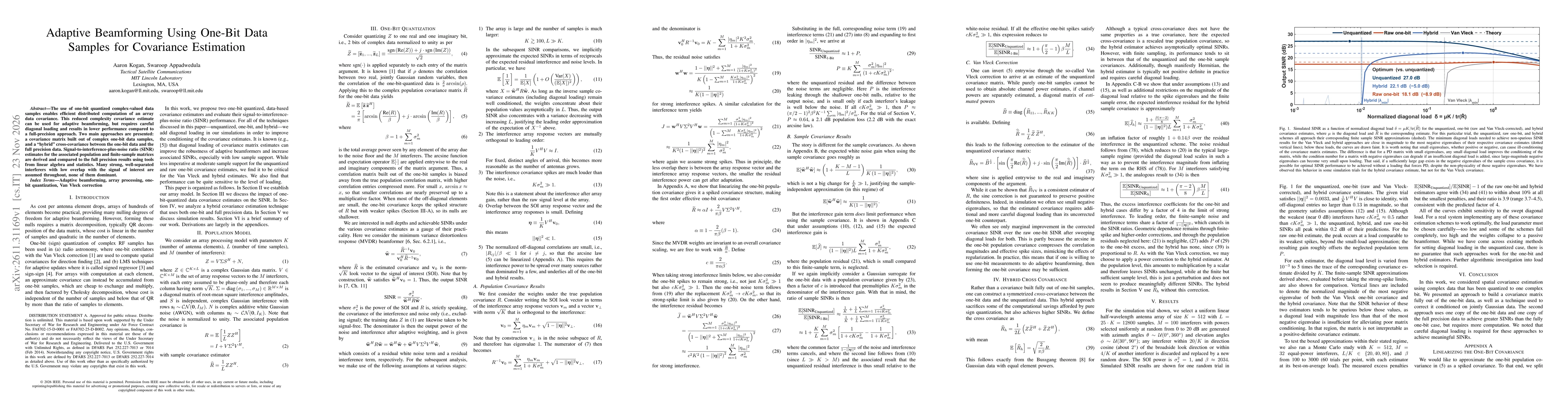
- Performance is highly sensitive to the amount of diagonal loading, especially for the hybrid estimator.
- The one‑bit covariance retains the spiked structure of the true covariance but with attenuated peaks, leading to shallower nulls.
LimitationsWhere the findings need caution
- Lower SINR performance compared to full‑precision approaches.
- Requires careful selection of diagonal loading; improper loading degrades robustness.
- Analysis assumes many strong, well‑separated interferers with low overlap and relies on linearized arcsine approximations.
MethodologyHow the work was done
The paper proposes two covariance estimation techniques for adaptive beamforming using one-bit quantized complex data: (1) a covariance matrix constructed solely from one-bit samples and (2) a hybrid cross‑covariance that combines one-bit and full‑precision data. Both estimators incorporate diagonal loading to improve conditioning, and analytical SINR expressions are derived for population and finite‑sample cases using linear algebra, the arcsine law, and Bussgang decomposition.
SignificanceWhy the work matters
Enables low‑complexity, distributed covariance computation for large antenna arrays, making adaptive beamforming feasible with minimal data exchange and hardware cost.
Technical contributionsWhat the work introduces
Derivation of closed‑form SINR estimates for one‑bit and hybrid covariance matrices, including the impact of diagonal loading and the use of Bussgang decomposition to model quantization effects.
NoveltyHow it differs from prior work
First systematic study of adaptive beamforming using covariance estimates built from one‑bit complex data samples and a hybrid one‑bit/full‑precision scheme.
Discussion 0