Agentic 3D Scene Generation with Spatially Contextualized VLMs
Researchers introduce a new approach to enable vision-language models to generate, understand, and edit complex 3D environments, achieving high-quality asset generation and enabling downstream tasks like interactive scene editing.
Abstract
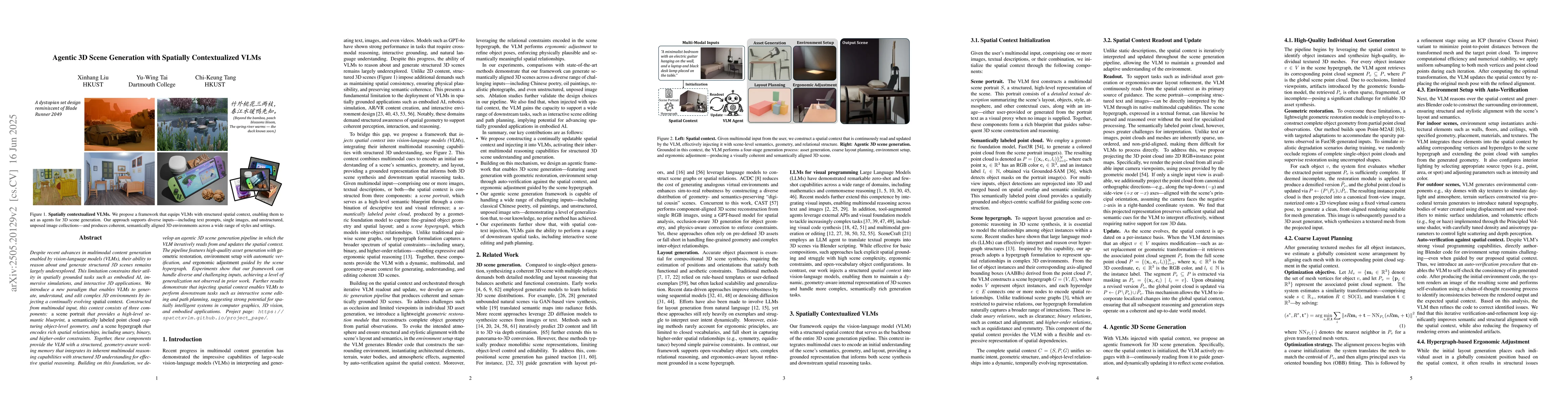
Despite recent advances in multimodal content generation enabled by vision-language models (VLMs), their ability to reason about and generate structured 3D scenes remains largely underexplored. This limitation constrains their utility in spatially grounded tasks such as embodied AI, immersive simulations, and interactive 3D applications. We introduce a new paradigm that enables VLMs to generate, understand, and edit complex 3D environments by injecting a continually evolving spatial context. Constructed from multimodal input, this context consists of three components: a scene portrait that provides a high-level semantic blueprint, a semantically labeled point cloud capturing object-level geometry, and a scene hypergraph that encodes rich spatial relationships, including unary, binary, and higher-order constraints. Together, these components provide the VLM with a structured, geometry-aware working memory that integrates its inherent multimodal reasoning capabilities with structured 3D understanding for effective spatial reasoning. Building on this foundation, we develop an agentic 3D scene generation pipeline in which the VLM iteratively reads from and updates the spatial context. The pipeline features high-quality asset generation with geometric restoration, environment setup with automatic verification, and ergonomic adjustment guided by the scene hypergraph. Experiments show that our framework can handle diverse and challenging inputs, achieving a level of generalization not observed in prior work. Further results demonstrate that injecting spatial context enables VLMs to perform downstream tasks such as interactive scene editing and path planning, suggesting strong potential for spatially intelligent systems in computer graphics, 3D vision, and embodied applications.
Analysis
AI-generated · verify against the original paper
Generated Jun 7, 2025ResultsWhat the authors found
- The framework can handle diverse and challenging inputs, demonstrating a level of generalization not observed in prior work.
- VLMs can generate high-quality 3D assets with geometric restoration, set up environments with automatic verification, and perform ergonomic adjustments guided by the scene hypergraph.
LimitationsWhere the findings need caution
- The paper does not explicitly discuss limitations within the provided content.
- Potential limitations could include computational resource requirements for generating and maintaining the spatial context.
MethodologyHow the work was done
The research introduces a new paradigm for VLMs to generate, understand, and edit 3D environments by injecting a continually evolving spatial context, comprising a scene portrait, a semantically labeled point cloud, and a scene hypergraph.
SignificanceWhy the work matters
This research is significant as it enables VLMs to perform spatially grounded tasks like embodied AI, immersive simulations, and interactive 3D applications, potentially impacting computer graphics, 3D vision, and embodied systems.
Technical contributionsWhat the work introduces
The main technical contribution is the development of an agentic 3D scene generation pipeline that integrates a structured, geometry-aware working memory with VLMs for effective spatial reasoning.
NoveltyHow it differs from prior work
This work stands out by focusing on spatially contextualized VLMs for 3D scene generation, introducing a scene portrait, point cloud, and hypergraph to provide a comprehensive spatial context, which is novel compared to existing VLM research.
Future workQuestions that remain
- Exploring the scalability of the approach for larger and more complex 3D scenes.
- Investigating the integration of real-time interaction and user feedback within the agentic 3D scene generation pipeline.
Discussion 0