An Agent-Based Framework for Automated Higher-Voice Harmony Generation
Abstract
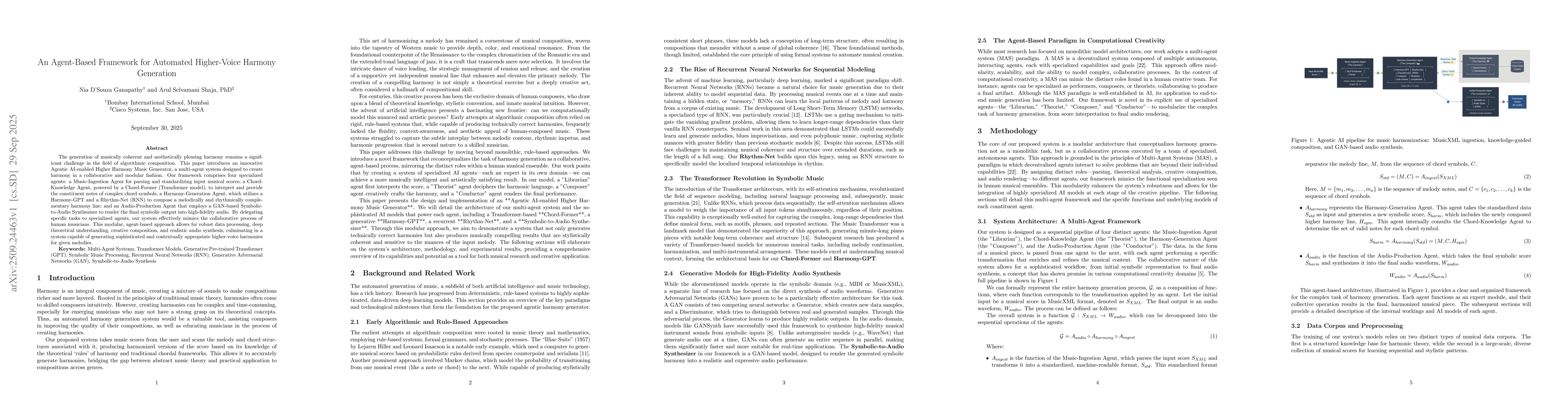
The generation of musically coherent and aesthetically pleasing harmony remains a significant challenge in the field of algorithmic composition. This paper introduces an innovative Agentic AI-enabled Higher Harmony Music Generator, a multi-agent system designed to create harmony in a collaborative and modular fashion. Our framework comprises four specialized agents: a Music-Ingestion Agent for parsing and standardizing input musical scores; a Chord-Knowledge Agent, powered by a Chord-Former (Transformer model), to interpret and provide the constituent notes of complex chord symbols; a Harmony-Generation Agent, which utilizes a Harmony-GPT and a Rhythm-Net (RNN) to compose a melodically and rhythmically complementary harmony line; and an Audio-Production Agent that employs a GAN-based Symbolic-to-Audio Synthesizer to render the final symbolic output into high-fidelity audio. By delegating specific tasks to specialized agents, our system effectively mimics the collaborative process of human musicians. This modular, agent-based approach allows for robust data processing, deep theoretical understanding, creative composition, and realistic audio synthesis, culminating in a system capable of generating sophisticated and contextually appropriate higher-voice harmonies for given melodies.
Analysis
AI-generated · verify against the original paper
Generated Sep 30, 2025ResultsWhat the authors found
- The framework successfully decomposes complex harmonization tasks into manageable sub-problems through functional specialization of AI agents
- The system demonstrates end-to-end music generation capabilities with technically coherent and aesthetically pleasing harmonies
- The approach provides a transparent and interpretable research platform for exploring computational creativity
LimitationsWhere the findings need caution
- The system's output is constrained by training data, leading to potential stylistic biases and limited versatility in underrepresented musical styles
- Computational costs are high due to the use of large-scale deep learning models, limiting real-time application on standard hardware
MethodologyHow the work was done
The research introduces an agentic AI framework for automated higher-voice harmony generation, combining multiple specialized AI models (Chord-Former, Harmony-GPT, Rhythm-Net, and GAN-based synthesizer) in a modular, collaborative system that mimics human musical specialization.
SignificanceWhy the work matters
This research advances automated music composition by creating a flexible, modular framework that aligns with human creative processes, offering new possibilities for musical AI systems that can generate complex, stylistically varied harmonies.
Technical contributionsWhat the work introduces
The technical contribution is the development of a modular agentic framework that integrates specialized AI models for music generation, providing a new paradigm for computational creativity in music composition.
NoveltyHow it differs from prior work
This work is novel in its agentic framework that mimics human musical collaboration through functional specialization, unlike previous monolithic models, and introduces a transparent research platform for exploring computational creativity.
Future workQuestions that remain
- Enhancing musical interactivity to develop real-time collaborative systems with human performers
- Implementing hierarchical structural planning agents for long-term musical coherence
- Expanding to full orchestration by integrating agents for basslines, counter-melodies, and percussion
- Diversifying training data to reduce stylistic bias and improve versatility across musical genres
Discussion 0